Today's Highlights
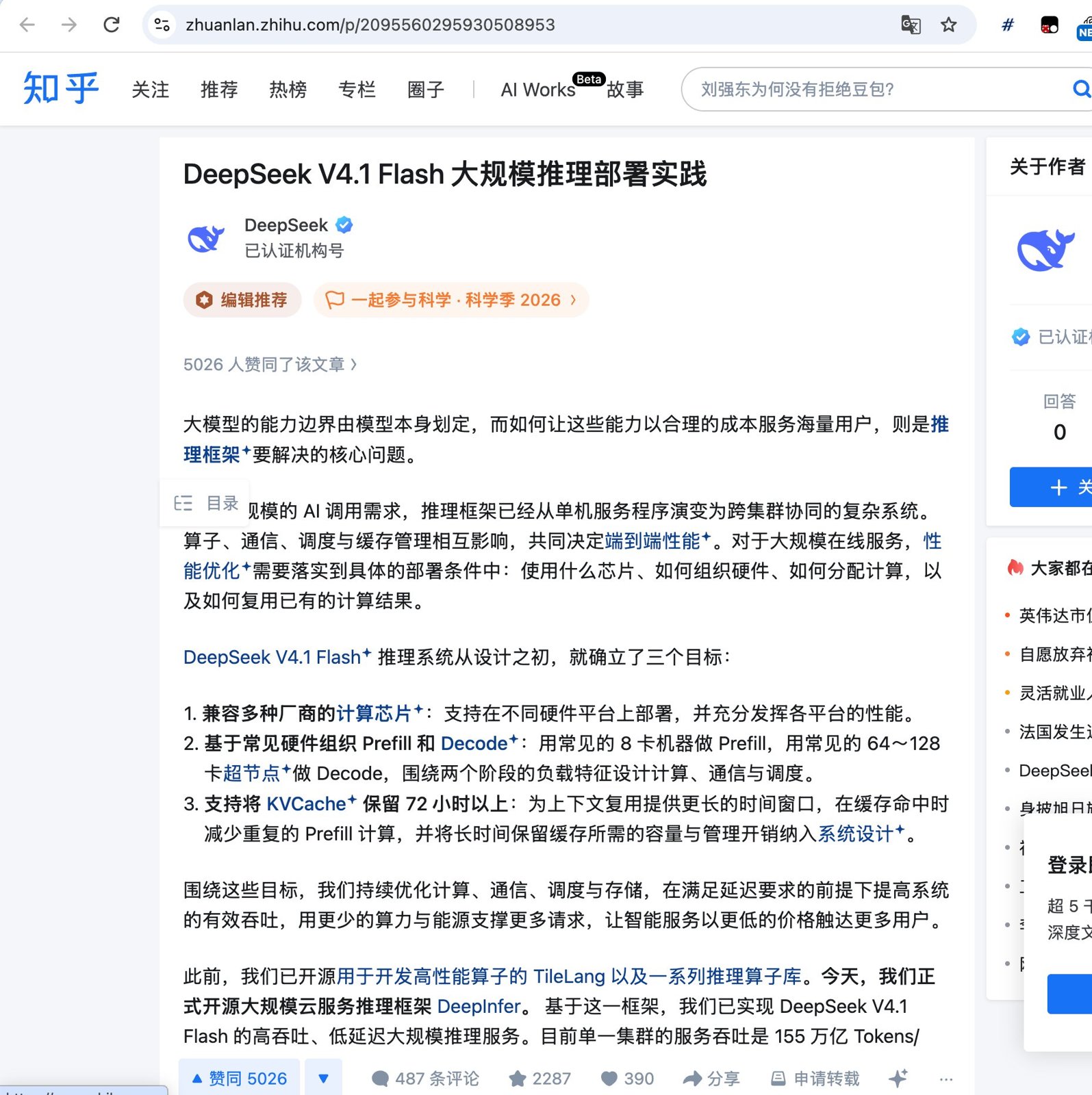
- DeepSeek open-sources its production inference engine, DeepInfer: The framework serving DeepSeek-V4.1-Flash in production is released under Apache-2.0 and runs on NVIDIA SM100 and Huawei Ascend 950.
- An explanation for the Codex usage drama: OpenAI says about 40,000 accounts had usage limits that didn't match the plan they chose; it's fixed, and affected users are being credited one by one.
- The TypeScript compiler gets a Rust port: Cloudflare and VoidZero launched tsrs, up to 8x faster than TS 7.0 with ~70% less memory at the same configuration; @steipete says his project already switched and got about 5x faster.
1. DeepSeek: open-sourcing DeepInfer, its production inference engine
Key points: @deepseek_ai open-sourced DeepInfer, describing it as the in-house inference framework powering DeepSeek-V4.1-Flash at scale, shared to help the community "lower compute costs, reduce energy use" (32k likes). The GitHub repo deepseek-ai/DeepInfer is Apache-2.0. Its README says it currently supports only DeepSeek-V4.1-Flash and offline inference, on NVIDIA SM100 and Huawei Ascend 950, with Attention DP, MoE EP + EPLB, speculative decoding (DSpark), batch-invariant inference, deterministic sampling and structured outputs. The KV cache system, prefill/decode disaggregation and load balancing across replicas needed for a full service are not included. @swyx pointed out that DeepSeek said more on Zhihu: as he quotes it, the V4.1 Flash service built on this framework does 155 trillion tokens per day per cluster and earns $38 per card per hour at off-peak prices. From that he estimates roughly an 80% serving margin at DeepSeek's own prices (swyx's estimate, not an official figure).
Why it matters: This is the inference stack actually used in production, not a reference implementation, and it supports Ascend too. That's a real reference for self-hosting and for China's domestic compute ecosystem. Without the KV cache and scheduling layers, though, you still can't reproduce DeepSeek's production costs.
- deepseek_ai: DeepInfer open-sourced: https://x.com/deepseek_ai/status/2112476496283775135
- swyx: the throughput and revenue figures from Zhihu: https://x.com/swyx/status/2112587397380943953
2. Codex: usage limits wrong on ~40,000 accounts, apology and credits
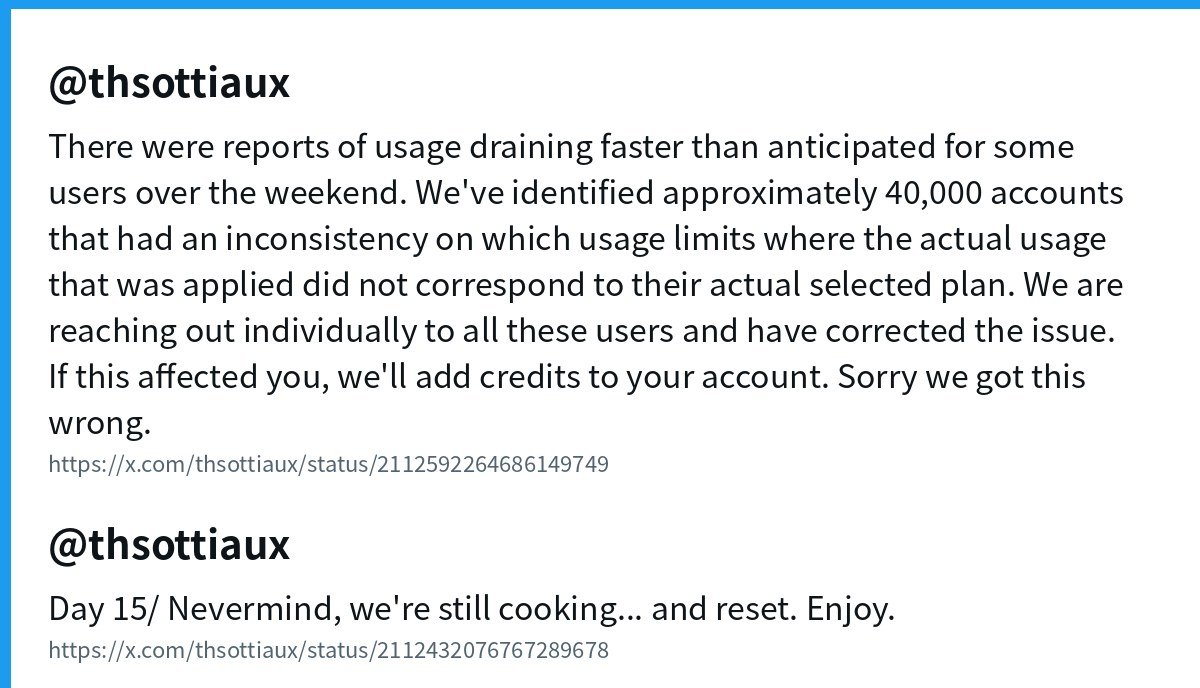
Key points: Responding to weekend reports of usage "draining faster than anticipated", Codex lead @thsottiaux said the team found about 40,000 accounts where the usage limit actually applied didn't match the user's selected plan. It's fixed, affected users are being contacted individually and will get credits: "Sorry we got this wrong" (8.9k likes). The same day he posted "Day 15": after saying "we're cooked" the night before, he switched to "still cooking" and reset everyone's limits again (11k likes). Not everyone was satisfied: @mkeremturhan wrote a long post saying users had complained for weeks that quota "vanished in minutes", listing issues such as GPT-6 Astra burning through limits on coding and fix-test-review loops wasting retries (all his claims), and asking OpenAI to "fix the meter" instead of handing out reset cards.
Why it matters: For a subscription coding agent, the core experience is predictable quota. Daily resets buy goodwill, but a broken meter costs trust.
- thsottiaux: ~40k accounts with mismatched limits, credits: https://x.com/thsottiaux/status/2112592264686149749
- thsottiaux: Day 15, another reset: https://x.com/thsottiaux/status/2112432076767289678
- mkeremturhan: a user's open letter: https://x.com/mkeremturhan/status/2112638419721417126
3. tsrs: a Rust port of the TypeScript compiler, up to 8x faster
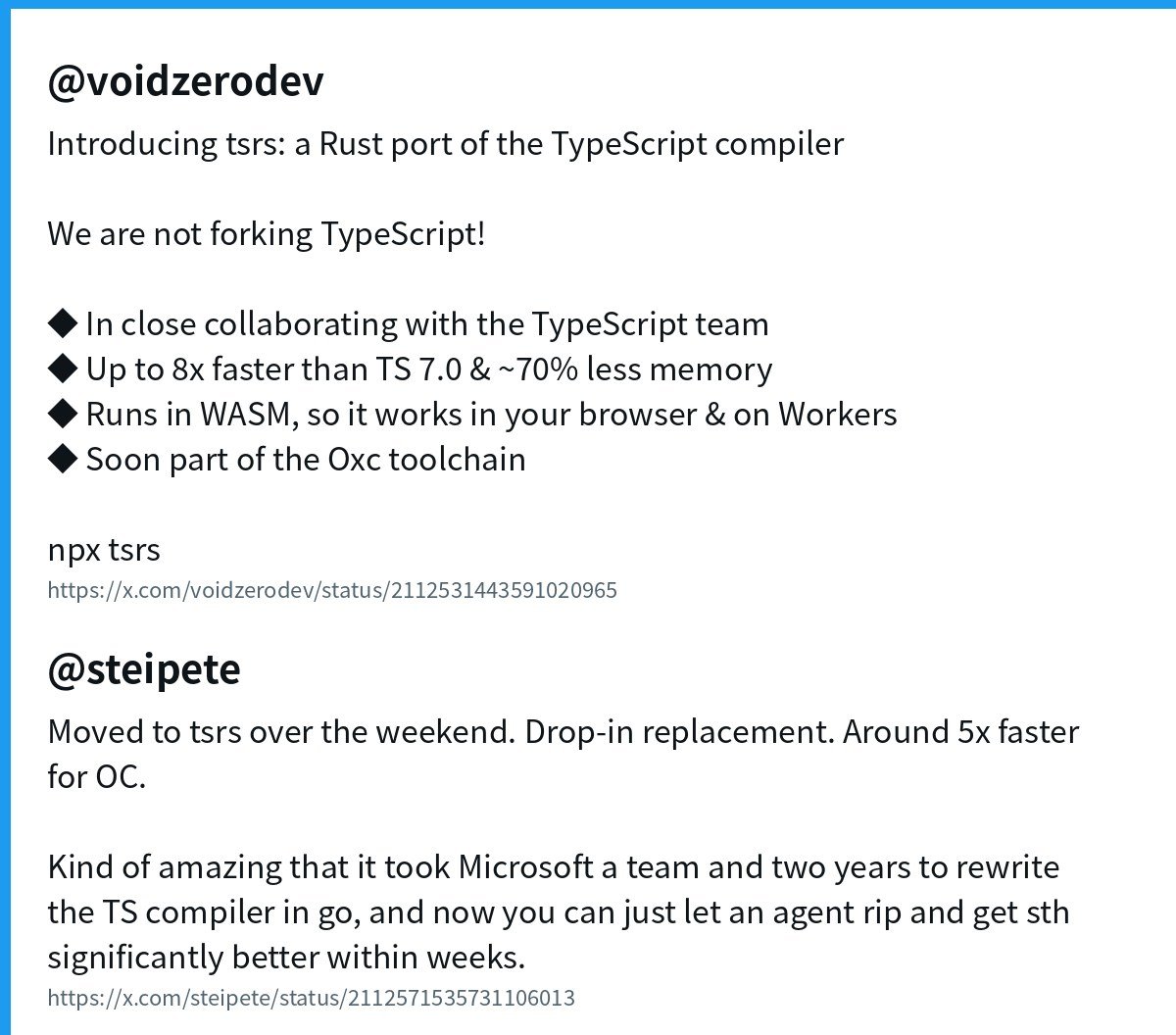
Key points: @voidzerodev launched tsrs, a Rust port of the TypeScript compiler (4k likes). According to the Cloudflare blog, it's a joint effort by Cloudflare, VoidZero and Max Schwenk of Owner.com, built in close collaboration with the TypeScript team. They explicitly aren't forking TypeScript, and language design stays with the TS team. Early benchmarks show it up to 8x faster with about 70% less memory than TypeScript 7.0 at the same number of type-check workers, and some optimizations have already gone upstream into TS 7.1 beta (up to 2.5x faster than 7.0). Because it's Rust, it compiles to WASM and runs in the browser and on Workers, and it will become part of the Oxc toolchain. The blog adds that they're working with Theo Browne to merge tsc-rs and tsrs into one package, and that agents will track upstream changes daily. @steipete said he moved his project to tsrs over the weekend: "Drop-in replacement. Around 5x faster". He noted it took Microsoft a team and two years to port the TS compiler to Go, while now "you can just let an agent rip and get sth significantly better within weeks".
Why it matters: Frontier models have turned large language ports from multi-year projects into weeks of work, which makes staying in sync with upstream the hard part. tsrs's answer is to work with the TS team and sync continuously with agents, one way such ports can stay sustainable.
- voidzerodev: tsrs launch: https://x.com/voidzerodev/status/2112531443591020965
- steipete: switched, ~5x faster: https://x.com/steipete/status/2112571535731106013
4. OpenAI: 12-hour prompt caching, team tasks, Orchestra Bio acquisition
Key points: @OpenAIDevs announced that the API now offers 12-hour prompt caching. Persistent agents like dots reuse the same instructions, tools and context all day, and can now pay the lower cached-input rate even when requests are hours apart (2k likes). ChatGPT launched "team tasks" for recurring engineering work, like a Friday summary of what shipped and what's blocked; teammates can review results and change what the next update covers (1.3k likes). @OpenAI announced it acquired Orchestra Bio, a platform that helps biopharma teams coordinate drug development, which will build on Rosalind, OpenAI's life-sciences models and tools (5k likes). Separately, @sama confirmed Aleksander Madry is returning to OpenAI to work on safety and security; Madry says what he thought was leaving "became more of a sabbatical".
Why it matters: 12-hour caching is priced squarely at always-on agents, a sign that persistent agents are now a usage pattern OpenAI takes seriously.
- OpenAIDevs: 12-hour prompt caching: https://x.com/OpenAIDevs/status/2112603916076781778
- OpenAIDevs: ChatGPT team tasks: https://x.com/OpenAIDevs/status/2112565702552940794
- OpenAI: Orchestra Bio acquisition: https://x.com/OpenAI/status/2112607347688583586
- sama: Aleksander Madry returns: https://x.com/sama/status/2112652656602923366
5. Claude / Anthropic: Claude designs scorpion-toxin binders, Opus 5.5 usage gets tight
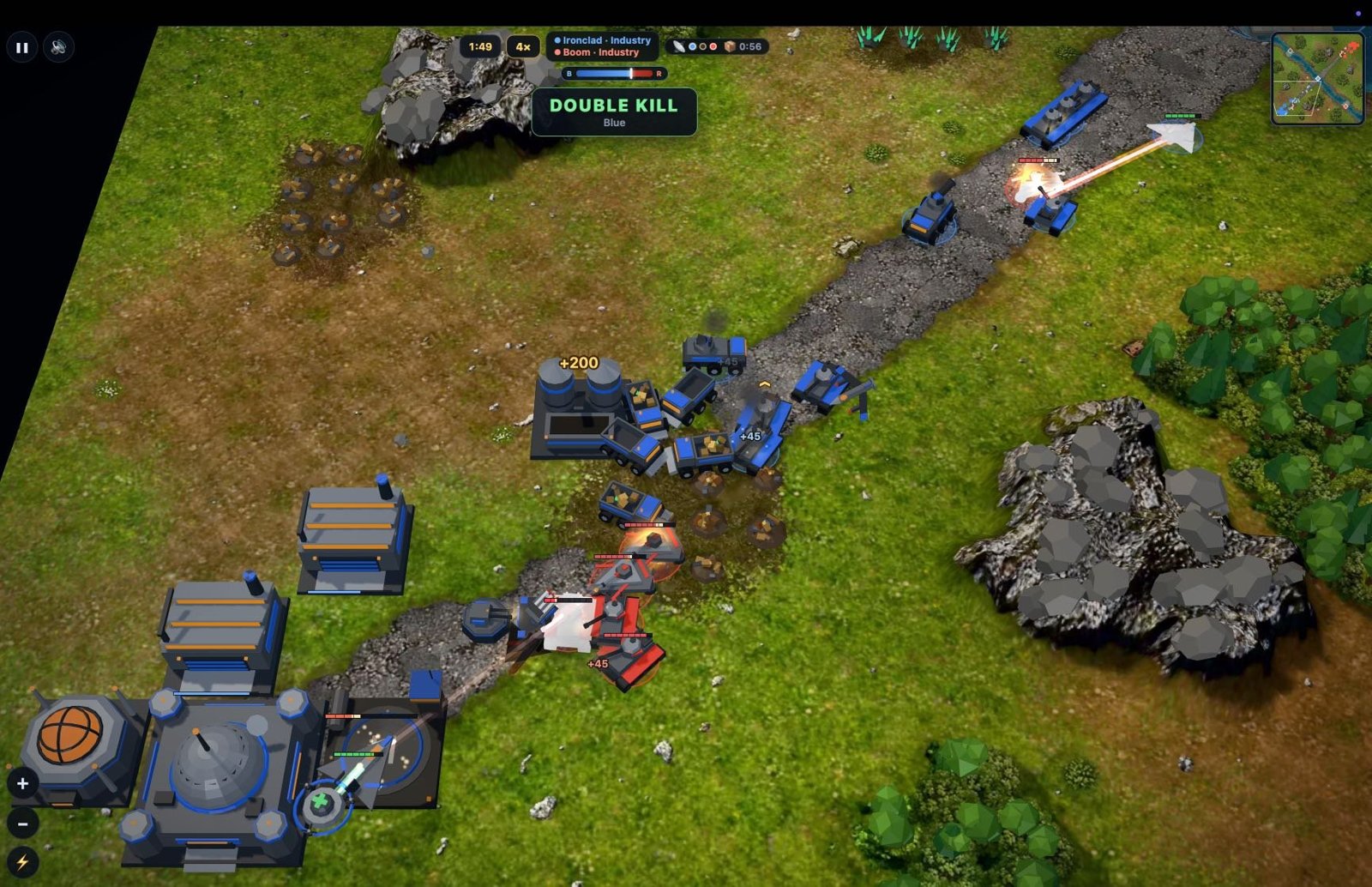
Key points: @AnthropicAI published an experiment on its Science Blog. An internal research model working in Claude Science spent about 64 hours, mostly on its own, designing small protein binders against scorpion neurotoxins. It generated 318,484 designs, 211 were lab-tested at two companies, and 17 met the binding criteria. Anthropic says plainly that neutralization hasn't been tested and it does "not claim to have produced an antivenom", and it released all 211 designs and their data (5k likes). On the developer side, Opus 5.5 talk centered on "great but expensive". @marouane53 said that when Opus 5.5 launched, Claude Code felt almost unlimited and he dropped his $200 Codex plan, but a few weeks later he hit the limit on two Claude Code Max subscriptions within 3 days (1.4k likes). @theo posted a video arguing Opus 5.5 is proof "the world does actually need smarter models". @simonw built Battle Drones, a browser RTS made mainly with Opus 5.5: Claude generated all the 3D models in Three.js, and it supports device-to-device multiplayer over an audio link.
Why it matters: The model is producing verifiable lab results from long autonomous research runs, while heavy users keep hitting quota walls. As capability climbs, how much of it you can afford matters just as much.
- AnthropicAI: scorpion-toxin binder design: https://x.com/AnthropicAI/status/2112579251555721573
- marouane53: two Max plans used up in 3 days: https://x.com/marouane53/status/2112501048711508232
- theo: "the world does actually need smarter models": https://x.com/theo/status/2112671665088024744
- simonw: Battle Drones, built with Opus 5.5: https://x.com/simonw/status/2112630778068881543
6. Grok Bot: recent updates in one video, and tagging it on X
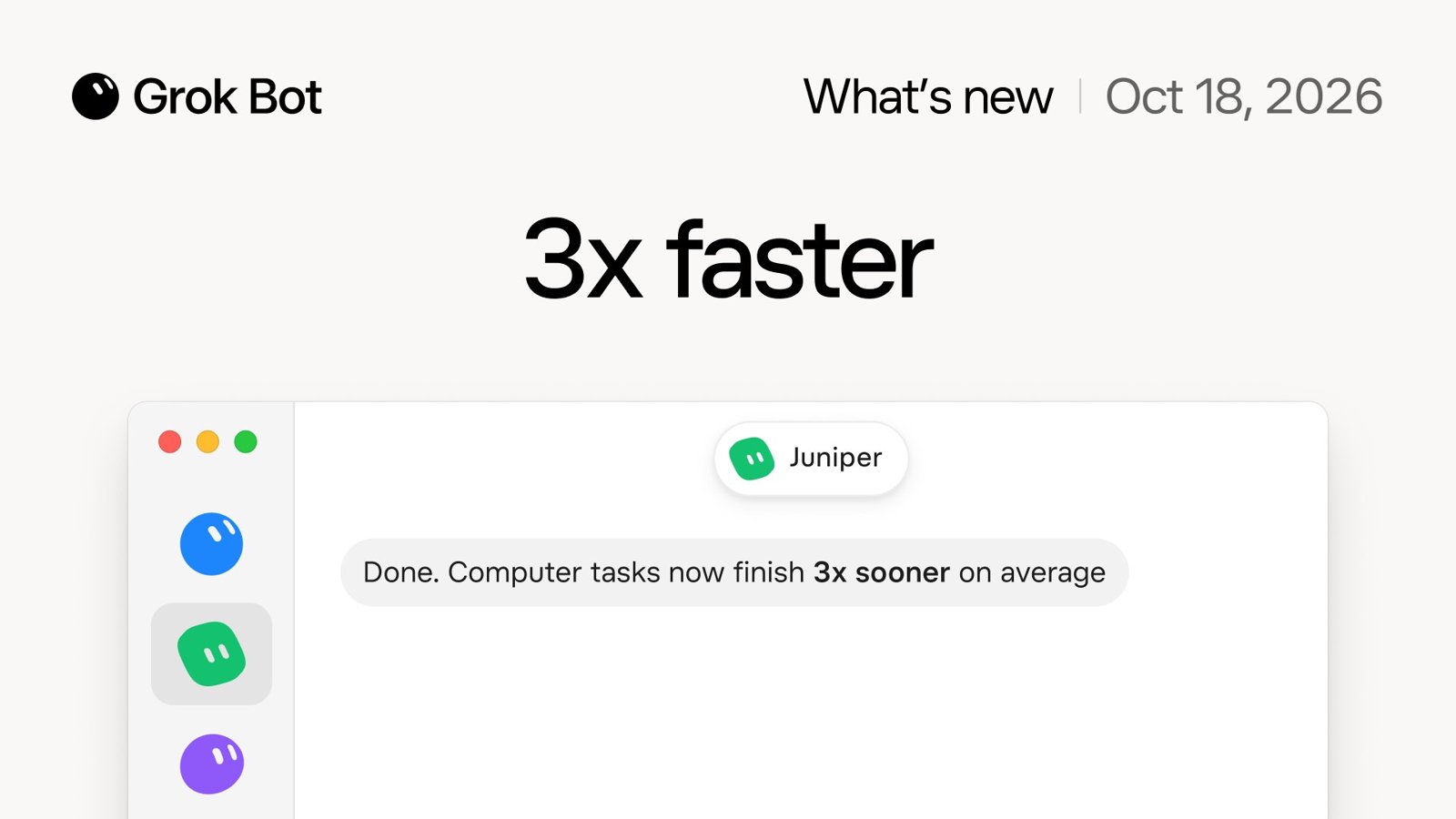
Key points: @mattyp posted a four-minute-plus "What's new in Grok Bot" video that walks through recent updates by timestamp: new chat cards, speed, draft edits, email aliases, X DMs, tagging @bot on X, connectors, voice calls, notifications, invites and Android Assistant, plus access lists, unread, routines and sign-in (4k likes, 2k bookmarks). @poteto, quoting Geoffrey Huntley's use of it, said one of his favorite features is tagging it on X, for example to read the replies to a post and turn them into a new bot.
Why it matters: Putting the agent where people already are (X, DMs, email, phone calls) is the main play for personal agents like Grok Bot.
- mattyp: What's new in Grok Bot: https://x.com/mattyp/status/2112550158885917122
- poteto: tagging it on X: https://x.com/poteto/status/2112606908893053223
7. Agent infrastructure: Vercel's durable-harness, Reason Network goes open source
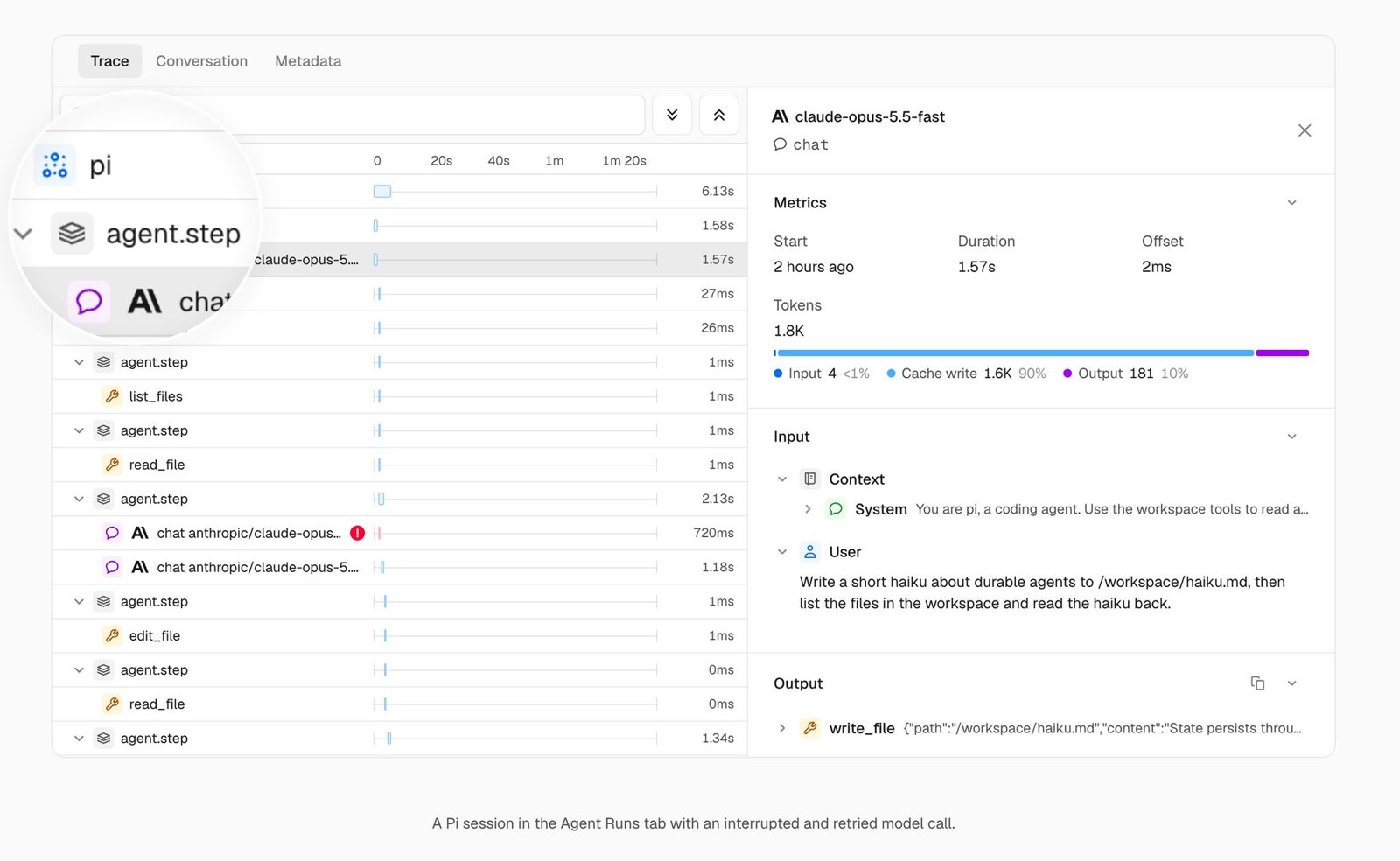
Key points: @vercel launched the open-source durable-harness, which makes harnesses like Pi, OpenCode, Codex and Claude Code run durably on Vercel, self-hosted Postgres or your laptop. It records an intent before each model or tool call and the outcome when it finishes. If a function crashes or times out, a new function reads the log and continues, and completed model calls are never billed twice. Tools can be marked replay: 'safe' or 'never', so things like refunds or PR comments don't run twice (500 likes, nearly 400 bookmarks). @rauchg added that Claude Code and Codex can be made durable and observable this way too, but they aren't currently designed for embedding: they need an extra sandbox and are less efficient and less portable than Pi or fx. Separately, @reasonmachines released Reason Network OSS, peer-to-peer encrypted messaging between agents such as Claude Code, Codex and Grok Bot; the GitHub repo is Apache-2.0 (1.4k likes, 2.1k bookmarks).
Why it matters: As agents move from local terminals to long-running cloud jobs, surviving crashes and talking to each other become new infrastructure needs.
- vercel: durable-harness: https://x.com/vercel/status/2112653833382027729
- rauchg: Claude Code / Codex can be durable too: https://x.com/rauchg/status/2112658577110520122
- reasonmachines: Reason Network OSS: https://x.com/reasonmachines/status/2112539998352523575
8. Long agent runs: OpenClaw swaps frameworks in ~600 PRs, theo's night of CI collapse
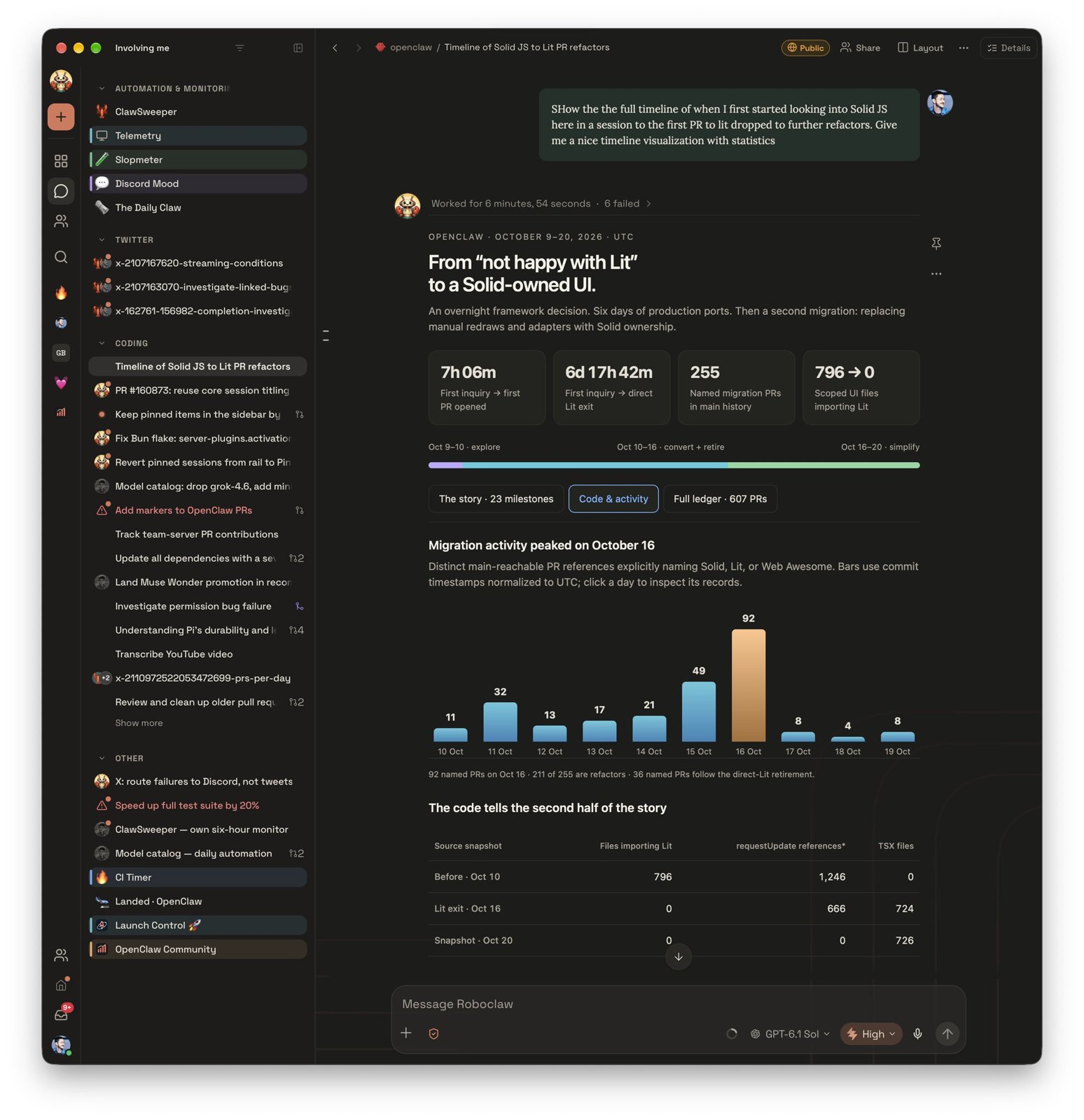
Key points: @steipete said that two weeks ago he started a loop to move OpenClaw's Lit-based web frontend to Solid 2.0. It took about 6 days to remove Lit and another week to make the code idiomatic Solid. He checked in every other day and "overall the process was mostly automatic", about 600 PRs in total, ending with a smaller JS/CSS footprint and finer-grained updates. @theo described the other side: a night where "all the vibe coded pieces collapse in front of you" and you realize "engineers are still very, very much necessary" (4.8k likes). He later added that most of the issues came from legacy vendors, GitHub Actions and flaky Chromium-driver tests, and the AI-written parts were the stable ones. The same day he said he'd vibe coded a Cargo alternative that compiles his Rust apps up to 129x faster, and his immediate thought was "yeah, and?".
Why it matters: Long-running agent loops can now handle a whole framework migration, but what blocks people is often old problems like CI and external dependencies. Where engineering judgment matters is shifting, not disappearing.
- steipete: OpenClaw moves to Solid 2.0: https://x.com/steipete/status/2112597162924351909
- theo: "engineers are still very, very much necessary": https://x.com/theo/status/2112492504511832509
- theo: the issues were mostly legacy deps and CI: https://x.com/theo/status/2112670864894550182
- theo: a vibe-coded Cargo alternative: https://x.com/theo/status/2112675779410895305
9. Coding-agent clients: OpenCode burns down issues after 2.0, T3 Code hits 4.5M turns a day
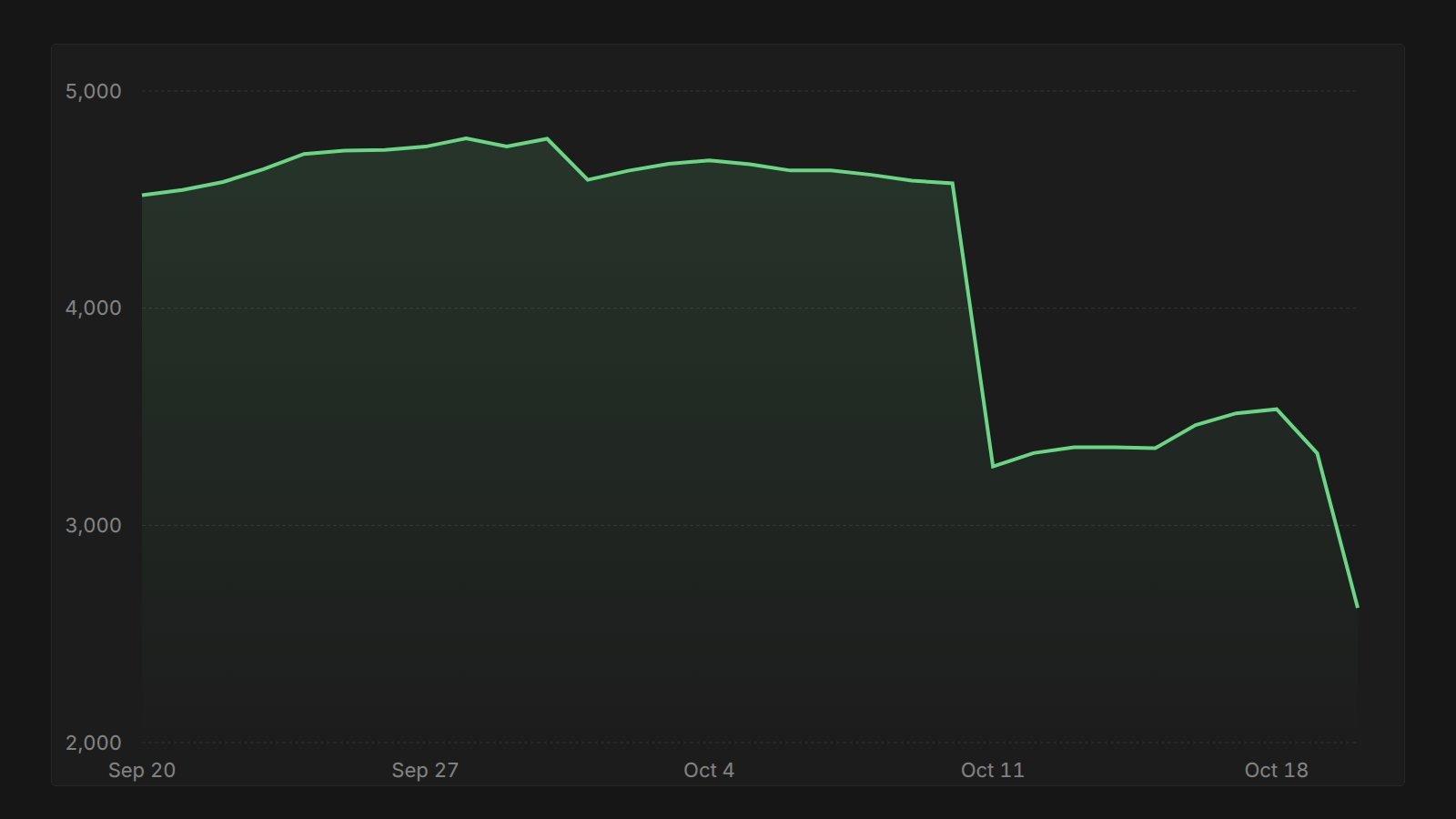
Key points: @thdxr said OpenCode 2.0 took a lot of the team's attention, so they were criticized for not addressing issues, but now that it's out "the team has been on fire burning down issues", with a chart of the issue count (1.4k likes). He also raised a new problem with open-source PRs: you don't know which model an outside PR used, and the team's internal setup gives the agent better tools, so such PRs are "almost always worse than sending the prompt ourselves". Their main value is for environments the team can't recreate. @theo said T3 Code users now complete over 4.5 million turns per day, with usage growing faster than the user count.
Why it matters: When maintainers' own agents beat contributors' agents, open-source contribution may shift from submitting code to submitting problems and environments.
- thdxr: burning down issues after OpenCode 2.0: https://x.com/thdxr/status/2112544276647231836
- thdxr: outside PRs vs. sending the prompt ourselves: https://x.com/thdxr/status/2112538272601616551
- theo: T3 Code at 4.5M turns per day: https://x.com/theo/status/2112678372128231766
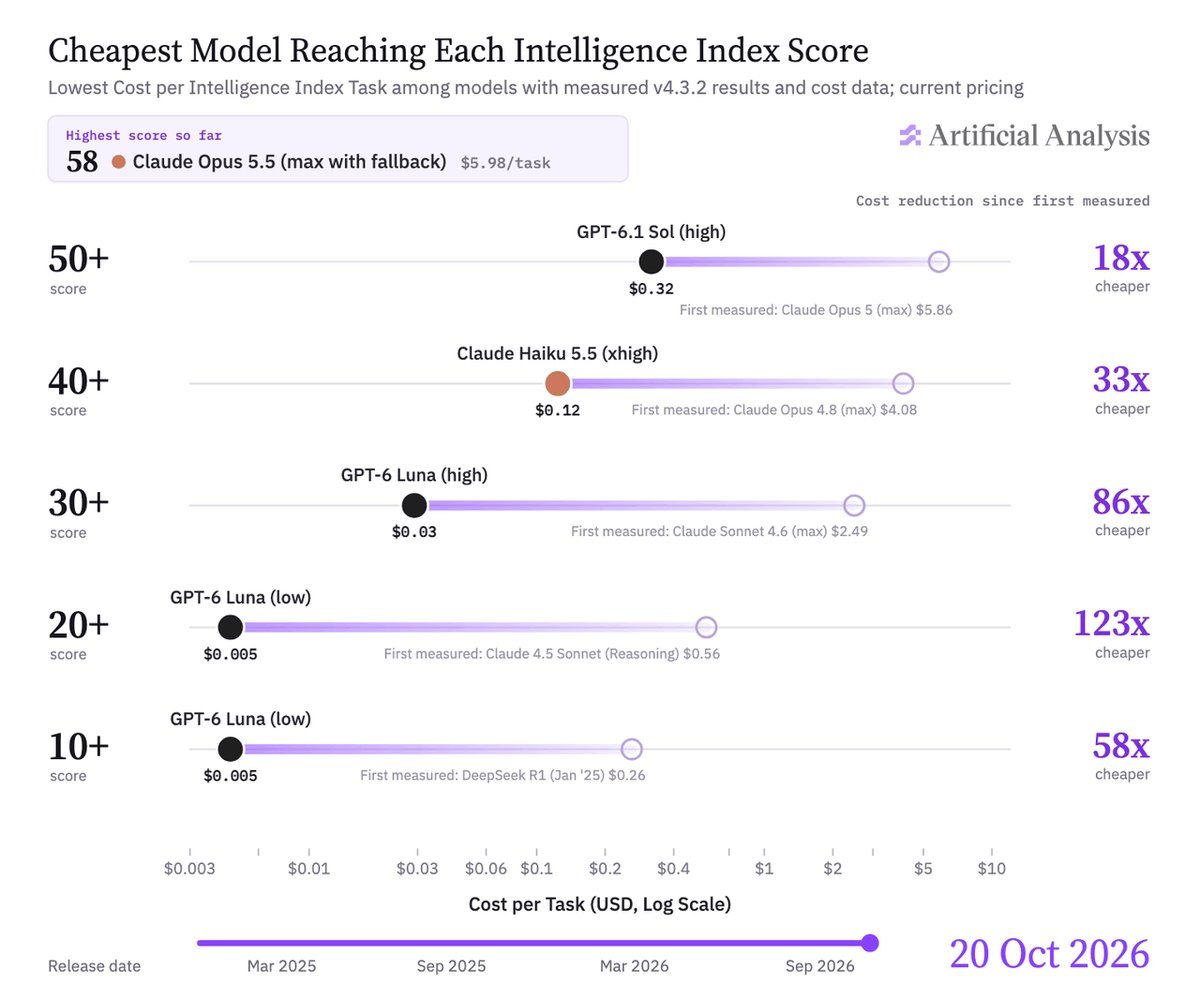
10. Artificial Analysis: the same intelligence is dozens of times cheaper, the top model costs more
Key points: @ArtificialAnlys published a cost analysis. Reaching 30 on its Intelligence Index now costs 86x less per task than when it was first reached: GPT-6 Luna (high) does it for $0.03/task, versus $2.49 for Claude Sonnet 4.6, which first reached 30 in February 2026. Reaching 20 is 123x cheaper, and reaching 40 is 33x cheaper, with Claude Haiku 5.5 (xhigh) the cheapest to reach 40 (score 41 at $0.12/task). Meanwhile, the top measured score rose from 21 to 58 in a year at about 11x the cost: Claude Opus 5.5 costs $5.98/task. The same day it also published model "personality" clusters: across 30 traits, Anthropic models group with OpenAI's GPT-6 models, and Google's with Meta's Muse.
Why it matters: "Fixed capability gets cheaper, top capability gets pricier" explains why cheap models are in a price war while heavy users keep hitting quota limits.
- ArtificialAnlys: cost to reach each threshold over time: https://x.com/ArtificialAnlys/status/2112582116651466965
- ArtificialAnlys: model personality clusters: https://x.com/ArtificialAnlys/status/2112578038990835765