AI Twitter Highlights · 2026-10-07
AI Twitter/X Highlights Digest · 2026-10-07 (Wed)
Today's Highlights
- Anthropic and Mistral took the headlines: Claude now lives in a sidebar inside Google Docs / Sheets / Slides (22K likes), the Claude Startups program is expanding, and the Cyber Verification Program now opens tiers for authorized offensive work such as penetration testing. Mistral released Mistral Large 4, with 1T total / 49B active parameters; it is API-only today, with open weights due at the end of October.
- OpenAI shipped on two fronts: Day 2 of Codex's "28 days" brought four updates at once: Auto-review is free and doesn't use plan usage, API usage tiers are simplified, a meeting-notes plugin, and the Decisions API in public beta. That evening OpenAI also published 722 math manuscripts produced by an internal frontier model.
- Tooling is filling in the infrastructure: Mitchell Hashimoto published OSC 7501, a terminal program-status spec meant to end the situation where 250+ agent orchestrators each guess whether Claude Code is stuck; Armin Ronacher wrote a long post on how Pi 1.0 uses Codemode to support MCP; and thdxr's "models improve faster than the tinkerers" post passed 10K likes.
1. Anthropic: Claude comes to Google Workspace, Startups expands, Cyber program loosens
Key points: @claudeai announced that Claude now works directly inside Google Docs, Sheets and Slides: it sits in a sidebar, reads the file you have open and edits it in place, and you can approve each edit before it lands. Those files can also be opened inside Claude. The post drew 22K likes and more than 6,000 bookmarks, the hottest AI post of the day. The same day, the Claude Startups program expanded: members get a year of Claude Team, API credits, deals on the tools a startup runs on, and office hours with Anthropic's Applied AI team. Startups founded in the last five years or funded in the last two can apply (9,500 bookmarks, more than its likes). @AnthropicAI also expanded its Cyber Verification Program: verified security professionals can use Claude Mythos 5.1, Opus 5.5 and Sonnet 5.5, and new tiers allow authorized offensive work such as penetration testing and red-teaming. Separately, Every shared the company agent they built on Claude Managed Agents, which the whole team uses in Slack.
Why it matters: Claude is moving from the chat window and the terminal into office documents, the main battleground, using an approve-each-edit model. Opening the Cyber program to offensive work responds to complaints that frontier models refuse too many security tasks (see Cline's eval in the next item).
- Claude for Google Workspace: https://x.com/claudeai/status/2107522596845822135
- Claude Startups expansion: https://x.com/claudeai/status/2107513494493179954
- Eligibility and events: https://x.com/claudeai/status/2107513501576999318
- Cyber Verification Program: https://x.com/AnthropicAI/status/2107546569654636883
- Every's company agent: https://x.com/claudeai/status/2107574195978641911
2. Mistral Large 4: the 1T-parameter "Le Chonk", weights at month-end
Key points: @MistralAI released Mistral Large 4 (nicknamed Le Chonk): 1T total parameters, 49B active, natively multimodal. Mistral calls it "the best open weights model from US or Europe," state of the art on cyber defense, manufacturing and finance workloads, ahead of closed frontier models on visual grounding, and deployable from Europe on Mistral's own cloud. The API is open today; open weights ship at the end of October. The post drew 35K likes and 6,000 bookmarks. @cline's eval says it beats Opus 5.5 and GPT-6 Astra on cybersecurity benchmarks, mostly because it refuses far fewer tasks: about 40% of tasks for the other two were blocked by their own safety filters. There was plenty of pushback too. @antirez pointed out that DeepSeek V4.1 scores higher on DeepSWE 1.1 and other benchmarks, and that Mistral didn't compare against the obvious models. @ClementDelangue noted that "you can't be the best open-weight model if you're not open-weight yet." @omarsar0 wasn't impressed by the performance but likes its multimodal and cyber direction. And @mitsuhiko said: "I know y'all are dunking on Mistral, but this is a significant step up."
Why it matters: This was the most-liked model launch of the day. For coding-agent users the real difference may be fewer refusals on security work and the option to deploy in Europe, not the leaderboard. Performance comparisons should wait for independent evals once the weights are out.
- Launch post: https://x.com/MistralAI/status/2107457414387622310
- Cline cybersecurity eval: https://x.com/cline/status/2107561157787824347
- antirez: https://x.com/antirez/status/2107511602807500958
- Clem Delangue: https://x.com/ClementDelangue/status/2107525319012090301
- Elvis Saravia: https://x.com/omarsar0/status/2107484943953621127
- Armin Ronacher: https://x.com/mitsuhiko/status/2107522381082198259

3. Codex Day 2: free Auto-review, Decisions API in beta
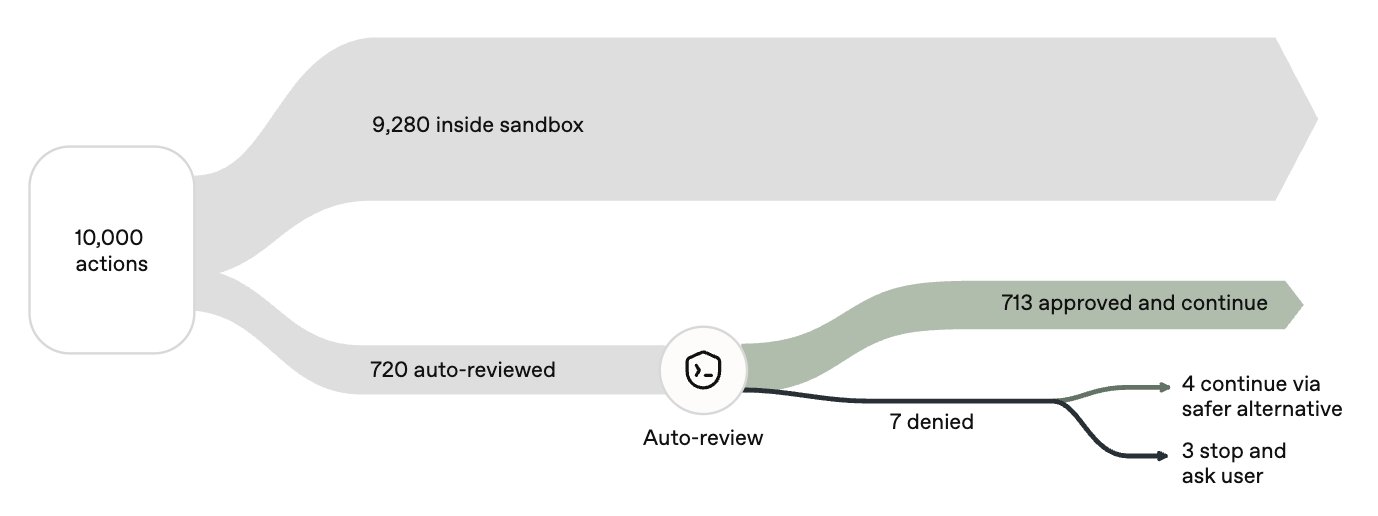
Key points: @thsottiaux's "28 days" reached Day 2, with four updates. 2.1: Auto-review ("Approve for me" in the permissions menu) is free for everyone signed in with a ChatGPT account and does not draw from plan usage. A second agent reviews every action the primary agent takes and blocks only high-risk actions or ones that drift from the user's intent, replacing the default sandbox where you approve everything (11.8K likes, 3,000 bookmarks). The example in the official chart: of 10,000 actions, 720 went to auto-review and 7 were denied; 4 of those continued via a safer alternative and 3 stopped to ask the user. 2.2: the five paid API tiers became three (Build / Launch / Grow), and $500 in total API payments now qualifies you for Grow, the top tier. 2.3: a Meetings plugin (beta) in the ChatGPT desktop app on macOS, so meeting notes can become context for Codex. 2.4: the Decisions API is in public beta for all developers; OpenAI says it makes decisions up to 10x faster than GPT-6 Luna through the Responses API. In the community, @ryanvogel benchmarked it against Jev and Clef and found it "FASTTT"; @theo answered the "route requests to the right model" pitch with just "Not again." He also said the $200 Codex plan feels reasonable with 6.1 Sol, while Astra is "pretty close to unusable."
Why it matters: Making Auto-review free drops the cost of running long tasks unattended to zero, a useful comparison point for the permission modes in Claude Code and other tools. The Decisions API puts OpenAI squarely in the "decision model" race alongside Jev and Clef.
- Day 2.1 Auto-review: https://x.com/thsottiaux/status/2107368734981517634
- Day 2.2 API tiers: https://x.com/thsottiaux/status/2107548725359104441
- Day 2.3 meeting notes: https://x.com/thsottiaux/status/2107573405553938664
- Day 2.4 Decisions API: https://x.com/thsottiaux/status/2107574912349303197
- Day 2 roundup: https://x.com/thsottiaux/status/2107575657014468879
- Decisions API vs Jev / Clef: https://x.com/ryanvogel/status/2107585541885861987
- Theo on plans: https://x.com/theo/status/2107419358234632635
4. OpenAI: 722 math manuscripts from an internal frontier model
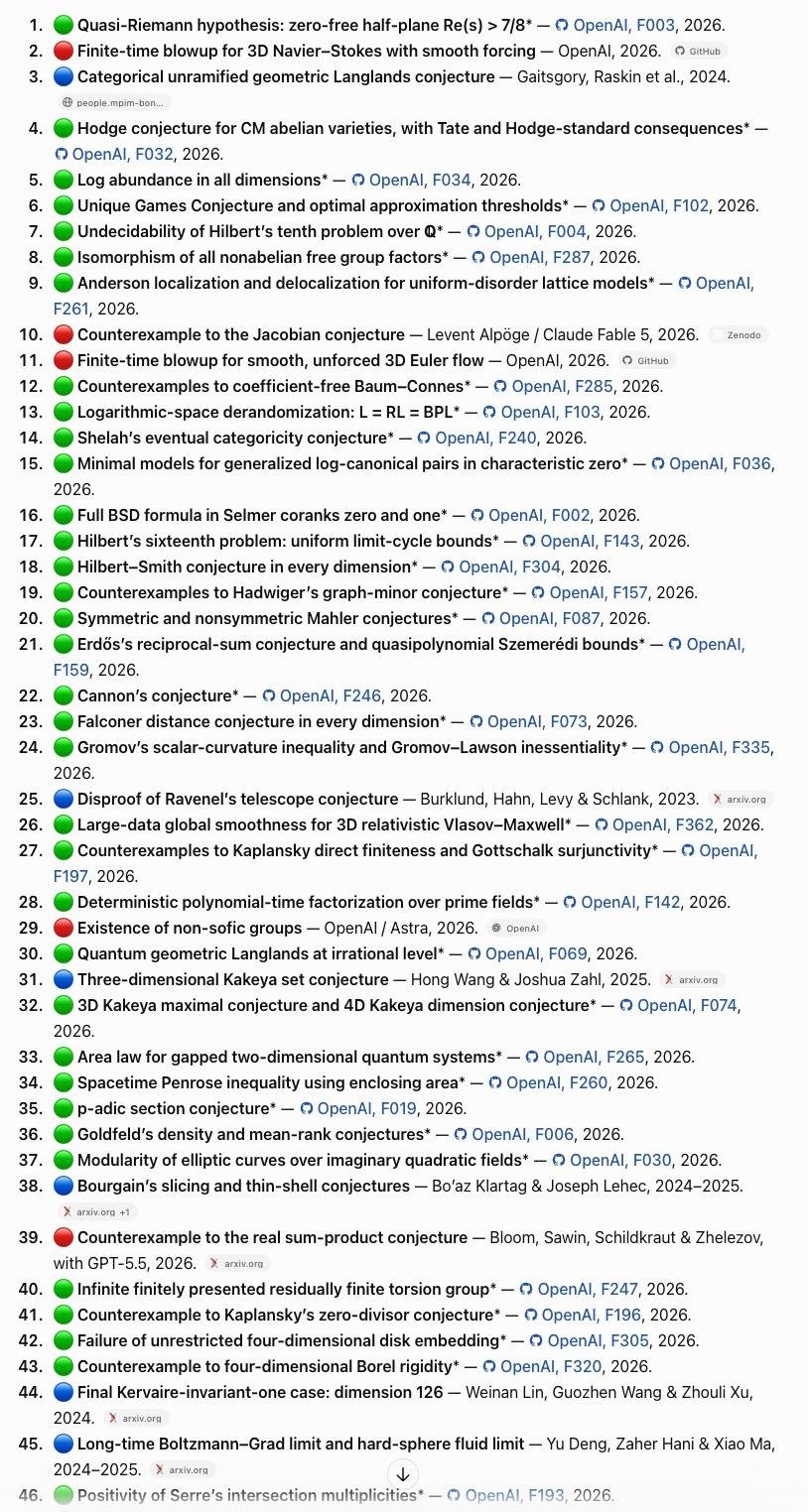
Key points: @OpenAI released a broad set of mathematical results produced by an internal frontier model, saying it shaped the release around advice from the independent Advisory Group on Mathematics and Artificial Intelligence at the Institute for Advanced Study. The GitHub repository openai/math was created on October 6 (UTC) and currently holds 722 manuscripts in 372 result families, with some Lean formalizations and 10 reasoning summaries. The README says most results came from the same unreleased internal model, averaging about three hours of ChatGPT Pro-level thinking compute per result, out of roughly 4,000 problems posed. Not every result has a Lean formalization, and "some of the unformalized results could have issues." @willdepue asked GPT-6 Pro and Fable 5.1 to rank the math discoveries of the last three years and found that more than 80% of the list was released today.
Why it matters: It isn't a coding product, but it was the day's most-watched model-capability signal: an unreleased model producing results on open research problems in bulk. OpenAI itself says verification levels vary, so the thing to watch is how formalization and peer review progress from here.
- OpenAI announcement: https://x.com/OpenAI/status/2107596713791767021
- Will Depue's ranking: https://x.com/willdepue/status/2107604920753070317
- Tibo's repost: https://x.com/thsottiaux/status/2107597780352950624
5. The Claude Code team: "Talk to Claude the way you would a coworker"
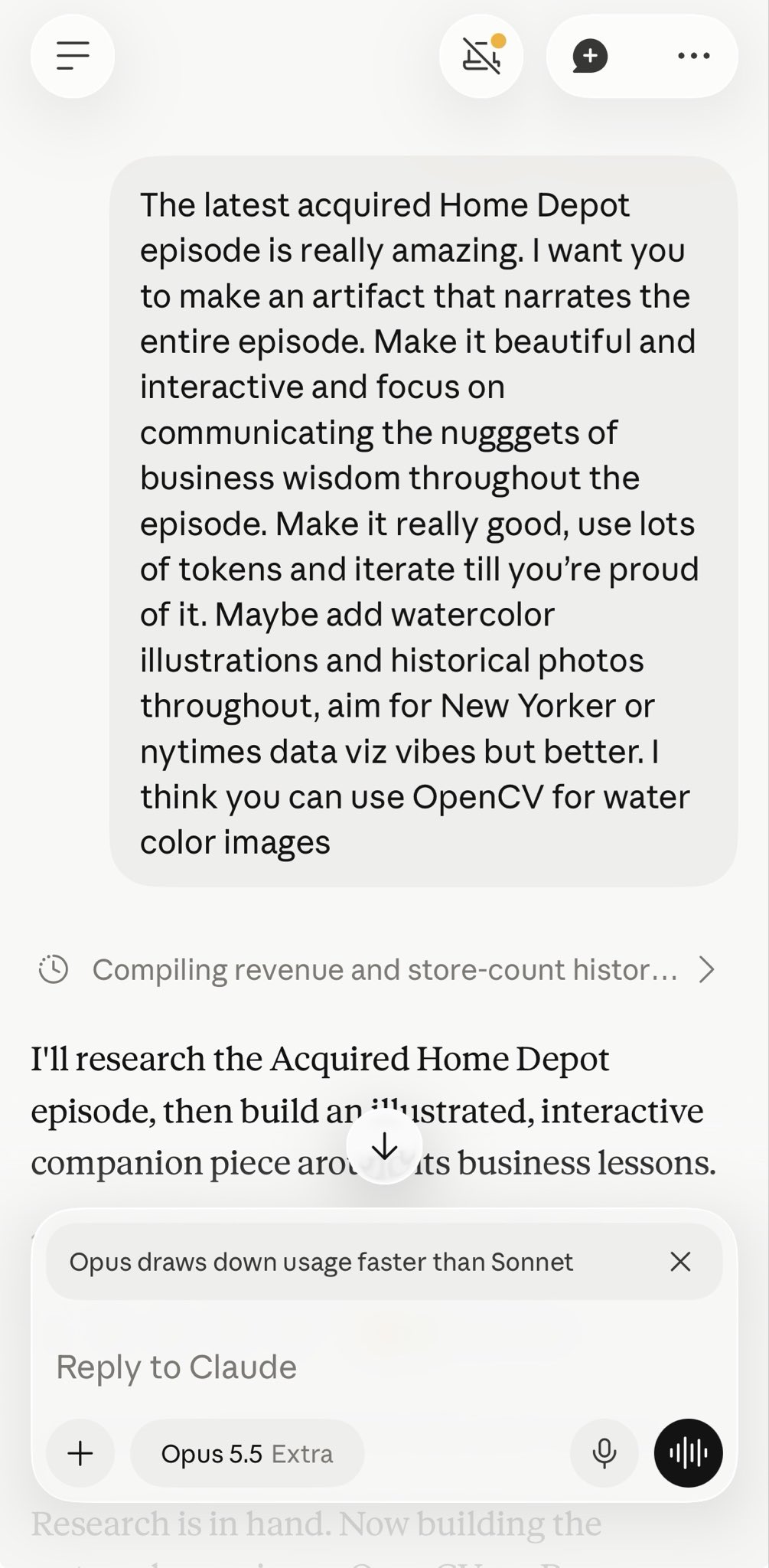
Key points: @bcherny (head of Claude Code) shared the raw prompt he used to have Opus 5.5 build an interactive companion site for Acquired's Home Depot episode. It was conversational, with almost no structure. He followed up with a longer post: there's no secret to prompting; talk to Claude the way you would a coworker. Back in the Sonnet 3.5 days the prompt mattered a lot; now what matters most is saying three things: what you want it to do, how much effort you want it to spend, and how it should verify that it did the right thing. That post drew 5,200 likes and 3,700 bookmarks. The same day @ClaudeDevs published a field guide to cloud sessions (a fresh VM per task, so you can run several at once and they keep going after you close your laptop), and @lydiahallie reminded people that the one-time bonus credit can be claimed with /claim-credit until October 7. @trq212 said Claude will increasingly keep its "brains" in the cloud and get "local hands" to operate your computer, and argued that working at a higher level of abstraction has always required understanding the lower levels, and coding agents don't change that.
Why it matters: The official team is personally endorsing "don't over-engineer prompts or harnesses," which reads well next to yesterday's harness debate. "Cloud brains plus local hands" also closely matches the Codemode design behind Pi in item 10.
- Boris's prompt: https://x.com/bcherny/status/2107532985897771152
- "Talk to Claude like a coworker": https://x.com/bcherny/status/2107565388250874193
- The finished site: https://x.com/bcherny/status/2107516876876362200
- Cloud sessions guide and credit: https://x.com/lydiahallie/status/2107543281924280730
- Cloud brains, local hands: https://x.com/trq212/status/2107580785456976085
- On abstraction layers: https://x.com/trq212/status/2107504677143368163
6. Grok Bot: two Team Bots that automate releases and QA
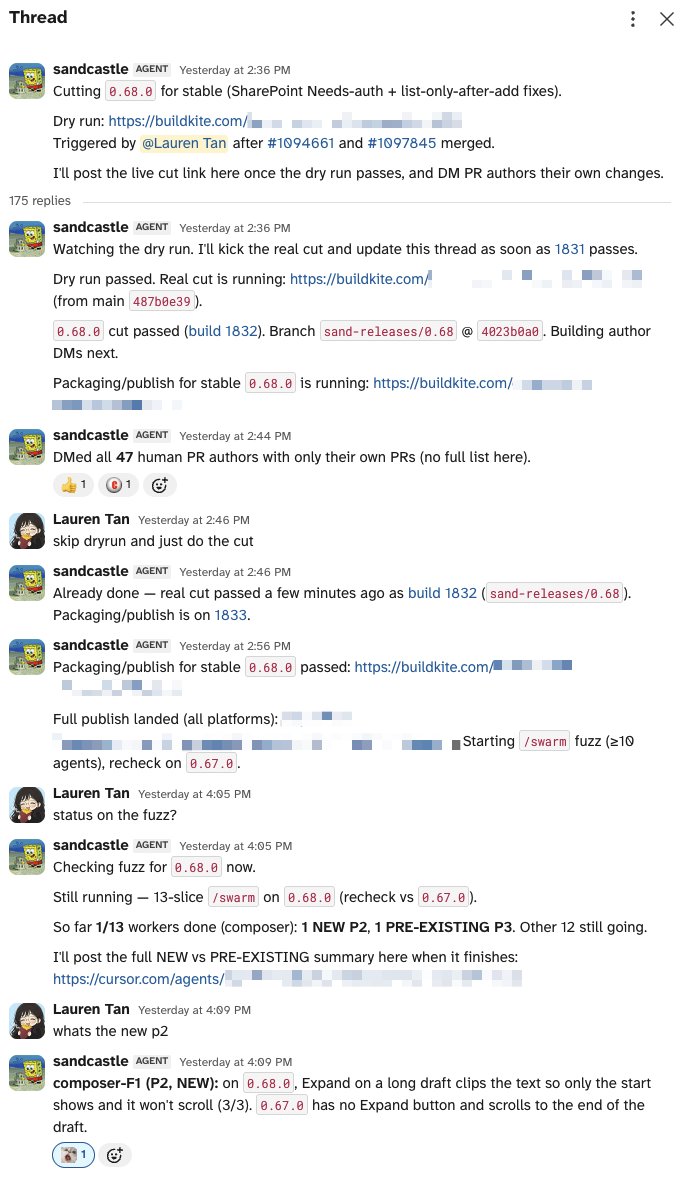
Key points: @poteto shared how she used Grok Bot to build two Team Bots that automate her team's release process. The release manager, sandcastle, cuts the release, DMs each contributor the PRs of theirs that are going out, watches the build, and then launches a fuzz swarm of 10+ agents running Grok 4.7 xhigh. Some follow verification skills and a feature map, and a few act as "chaos monkeys" clicking at random. When an issue turns up, it @-mentions the engineer bot, which spins up a Cursor Project to triage and fix it, and cherry-picks the fix into the release branch for a patch release when needed. The post drew 1,500 likes and more than 1,000 bookmarks. In another post she said Grok Bot is best at the "first mile and last mile" of work: connect your calendar, CRM, Slack and email so the bot can find the work worth doing, then use routines to trigger it on a schedule or on events. @turingou has Grok Bot read through all of their X bookmarks, sort them by use cases in their projects, and hand them to Codex / Claude Code on a server, which then decide whether anything should be built.
Why it matters: This is a real production example of handing the whole release → test → fix chain to multiple agents, and it maps directly onto your own team's release process.
- Release and QA automation: https://x.com/poteto/status/2107527180263829827
- The first and last mile: https://x.com/poteto/status/2107510472601985336
- Bookmarks → daily brief → Codex / Claude Code: https://x.com/turingou/status/2107456093266076102
7. OpenCode / thdxr: "The models improve faster than the tinkerers"
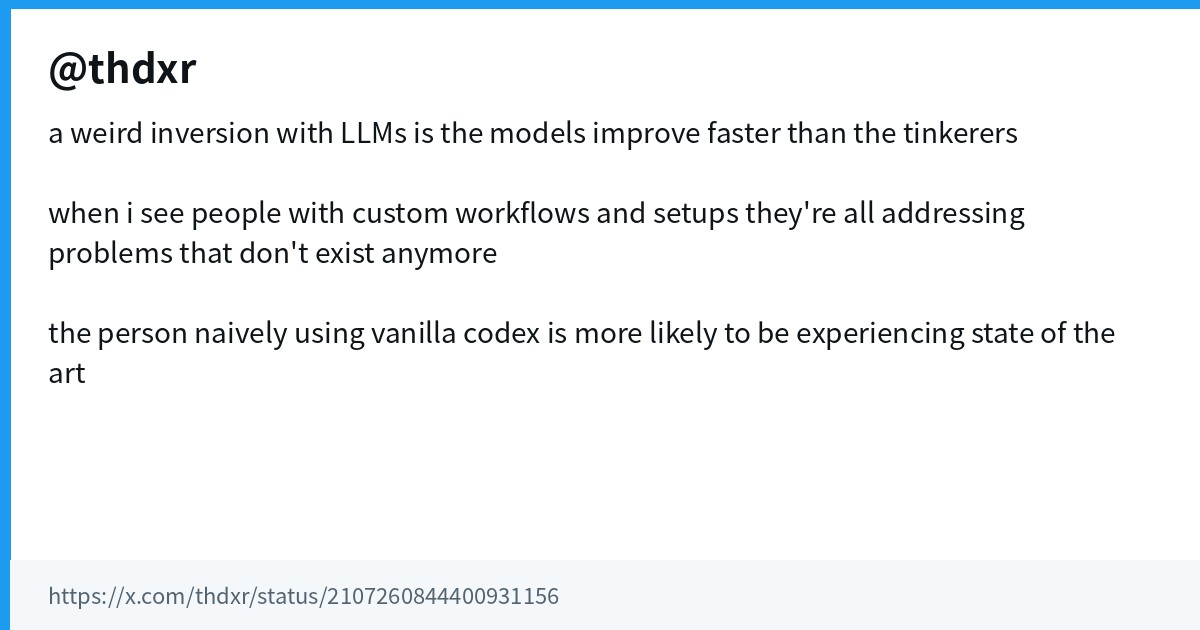
Key points: OpenCode creator @thdxr posted that LLMs bring a weird inversion: the models improve faster than the people tinkering with workflows. Many custom setups solve problems that no longer exist, and "the person naively using vanilla codex is more likely to be experiencing state of the art." The post passed 10K likes and 1,500 bookmarks, and the replies were heated. He later added that most of his work over the past week was done from the OpenCode iPhone app; that he has run OpenCode on an always-on server since day one, so his experience is probably the best possible but not the most common; and that you can build all kinds of agent frontends on opencode server.
Why it matters: It's the same question as Boris's "don't over-engineer prompts" in item 5 and yesterday's harness debate: while models are iterating this fast, is customization an asset or a liability?
- "Models improve faster than the tinkerers": https://x.com/thdxr/status/2107260844400931156
- Working from the iPhone app: https://x.com/thdxr/status/2107581093838832003
- An always-on server: https://x.com/thdxr/status/2107581841314365551
- Frontends on opencode server: https://x.com/thdxr/status/2107587003965489643
8. T3 Code: agents draw visualizations right in the thread
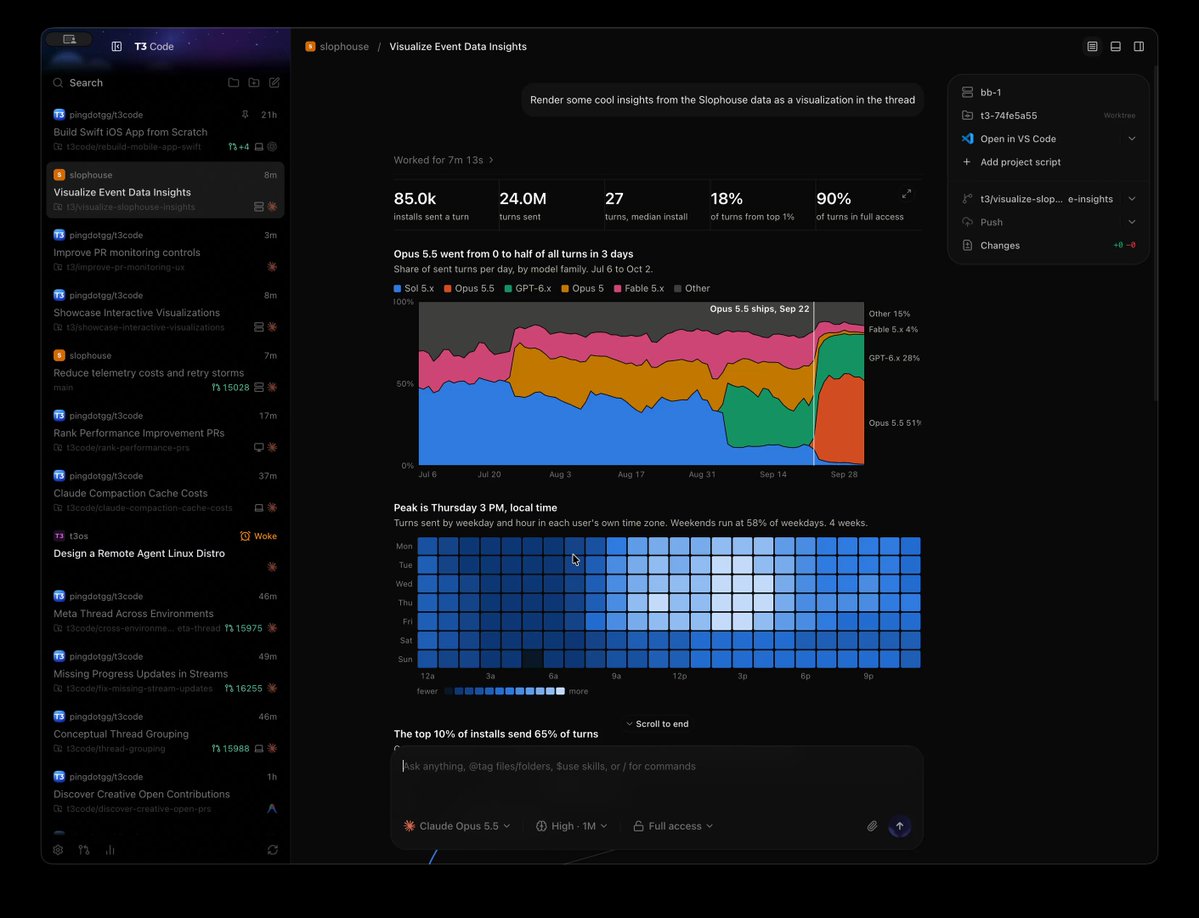
Key points: @theo announced in-app visualization in T3 Code: agents can build dynamic, interactive charts and interfaces directly in the thread, using the CSS variables of your selected theme so they always match the app (built mostly by @davis7). The post drew 4,000 likes and 1,200 bookmarks. He then showed Opus 5.5 producing real mocks for five different UI treatments and rendering them in the thread, calling it incredible for comparing UI options, and said T3 Code went from 400K to 450K users in four days.
Why it matters: Coding-agent output is no longer just diffs and text. Rendering interactive results in the thread is becoming a new point of competition between clients.
- In-app visualization: https://x.com/theo/status/2107269392874782873
- Theme compatibility: https://x.com/theo/status/2107271582565765398
- Mocks for five UI treatments: https://x.com/theo/status/2107615261893464226
- 400K → 450K users: https://x.com/theo/status/2107599549716156785
9. Ghostty's creator publishes OSC 7501: programs tell the terminal "busy" or "waiting on you"
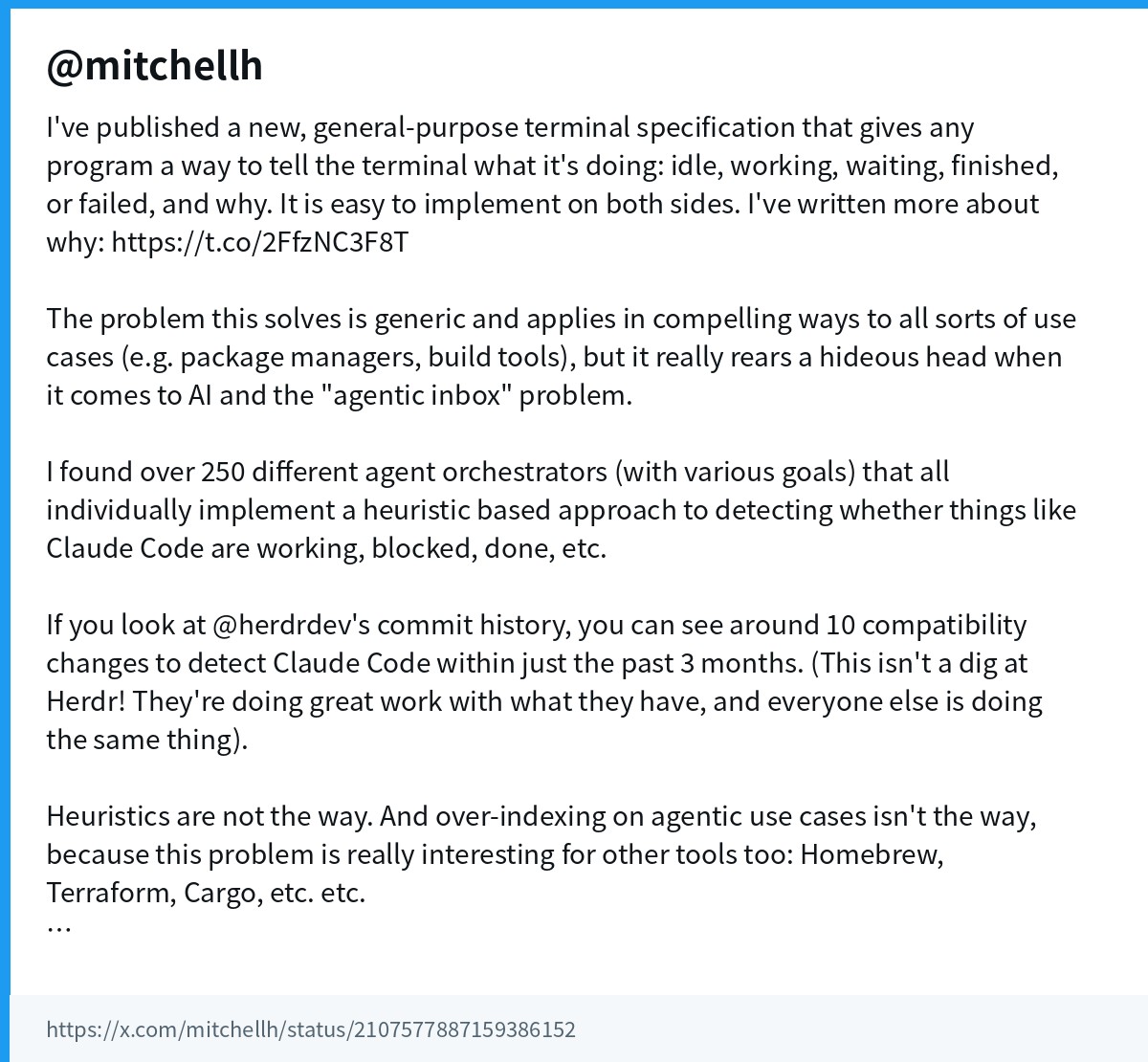
Key points: @mitchellh (creator of Ghostty) published a general-purpose terminal spec, Program Status (OSC 7501), that lets any program tell the terminal whether it is idle, working, waiting, finished or failed, and why. It is easy to implement on both sides. His motivation is the "agentic inbox" problem: he counted more than 250 agent orchestrators that each use heuristics to work out whether tools like Claude Code are working, blocked or done. Herdr alone made about 10 compatibility changes to detect Claude Code in the past three months. He argues that heuristics, proprietary protocols and out-of-band APIs are all the wrong answer (the latter two have an O(N) integration problem and are awkward over SSH and in containers), and that the spec is just as useful for tools like Homebrew, Terraform and Cargo.
Why it matters: If CLI agents like Claude Code, Codex, OpenCode and Pi adopt it, the "which agent is waiting on me" signal when you run several at once becomes a deterministic signal instead of a guess.
- Announcement: https://x.com/mitchellh/status/2107577887159386152
10. Pi: Armin explains Codemode and splitting the "brain" from the "hands"
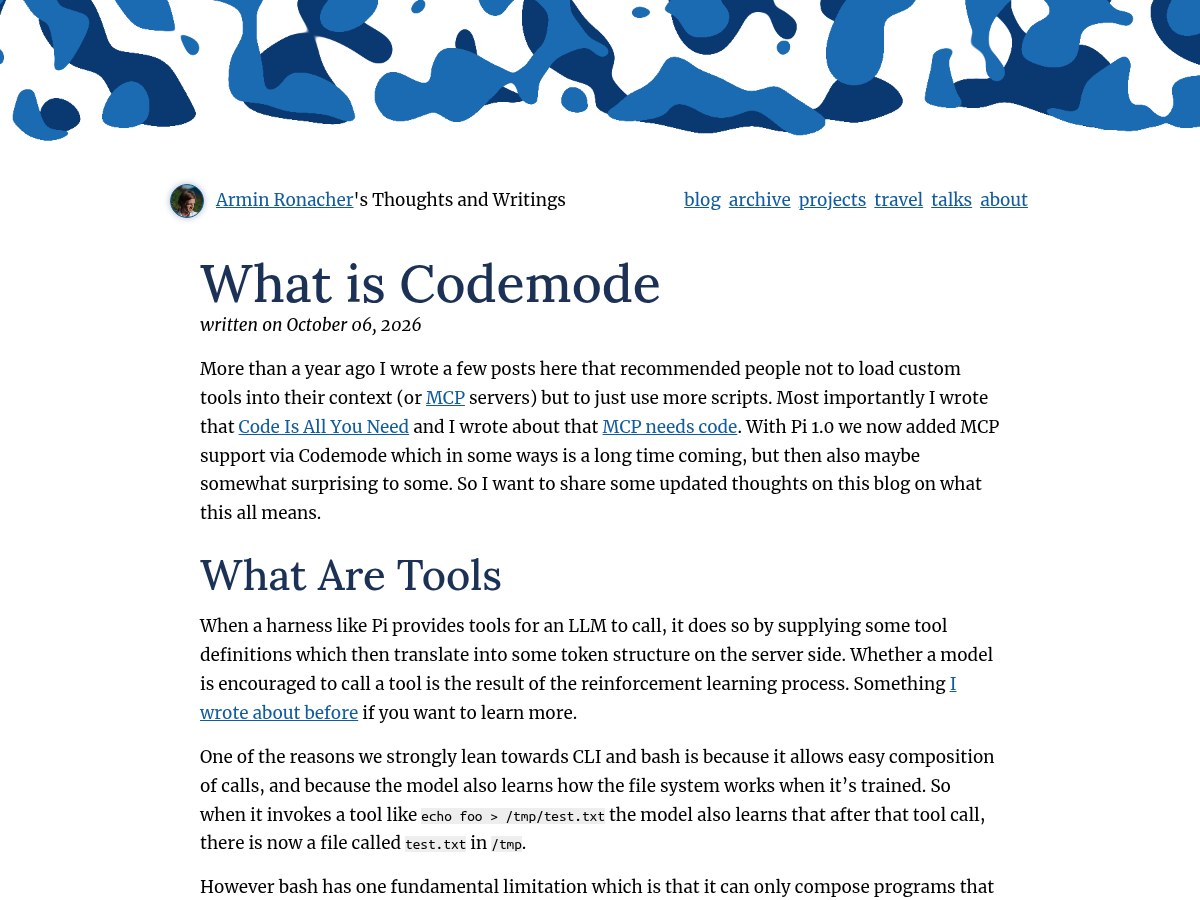
Key points: @mitsuhiko (Armin Ronacher) wrote a long post, "What is Codemode," explaining why Pi 1.0 added MCP support through Codemode. A year ago he argued against loading custom tools into context and for simply using more scripts. His updated view: bash can only compose programs that run, while capabilities like reading images or spawning subagents have to be native to the harness. The key is to separate the harness, the trusted "brain," from the "hands" that execute tools (Pi calls this the execution environment, which can be a sandbox or another machine). Codemode lets the LLM write code that orchestrates complex operations on the harness side. It runs in QuickJS inside a WASM runtime, deliberately with no network, no file system and no timers, so the only thing it can do is call more tools. Pi creator @badlogicgames reposted it as "recommended reading," and the post has close to 1,000 bookmarks.
Why it matters: It's the clearest explanation so far of which side tool calls should live on, and it lines up with Anthropic's "cloud brains, local hands" direction in item 5. Teams building agent runtimes or wiring up MCP should read it closely.
- Codemode post: https://x.com/mitsuhiko/status/2107464890180927782
- Mario's recommendation: https://x.com/badlogicgames/status/2107495556406738992