AI Twitter Highlights · 2026-09-27
AI Twitter/X Highlights Digest · 2026-09-27 (Sun)
Key Takeaways
- Codex comes back after a brief outage and resets paid usage limits; the same day, T3 Code usage shows Claude roughly 2× more popular than Codex.
- Jev Router gets a hard DeepSWE bake-off against GPT-6 Astra; OpenCode doubles down on “it’s the harness”; Cline ships free stealth model Pixel Canary.
- OpenClaw highlights Microsoft contributing upstream; Opus 5.5 keeps winning on efficiency/quota feel; plus DeepSeek Harness plugins, OmO v5 (pi), and MIT’s minimal JAZ harness paper.
1. Codex is back — paid limits reset
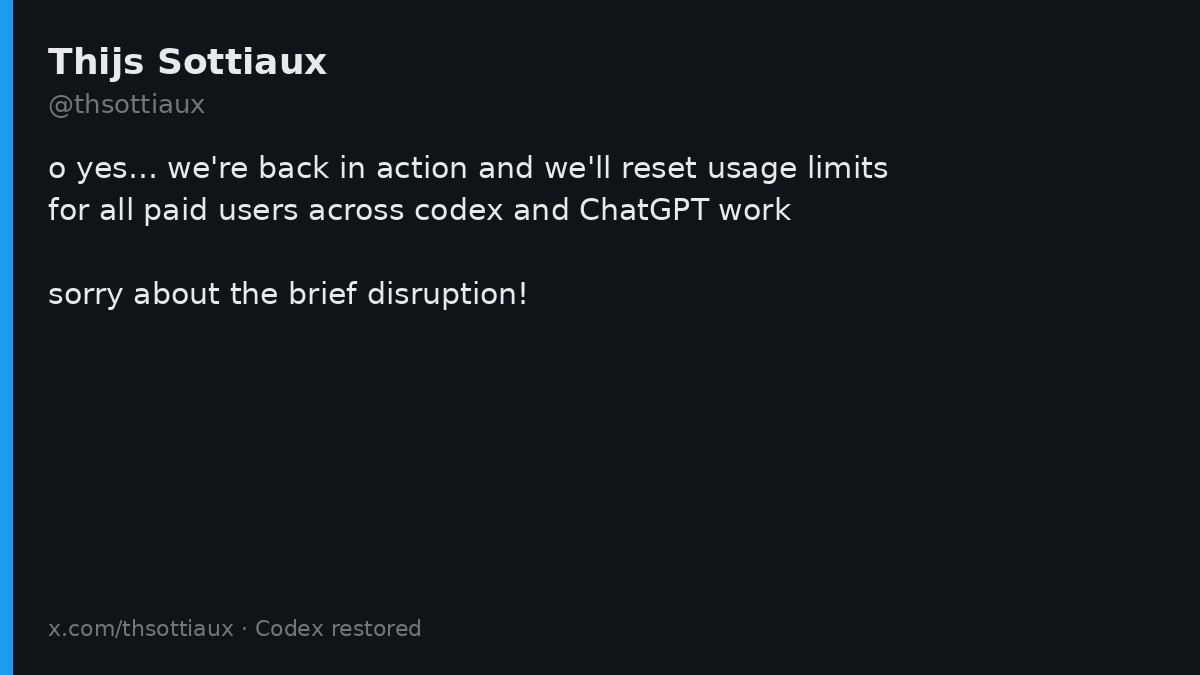
Summary: OpenAI’s @thsottiaux announced Codex and ChatGPT work are back online after the brief disruption, and that usage limits will be reset for all paid users. He also joked about a “special spare Codex” that helps when things are down — closing the loop on the prior evening’s outage posts.
Why it matters: For cloud coding agents, availability and make-goods are part of the default-tool decision, not just model quality.
- Restore note: https://x.com/thsottiaux/status/2103637477760311522
2. T3 Code: Claude flips Codex ~2×
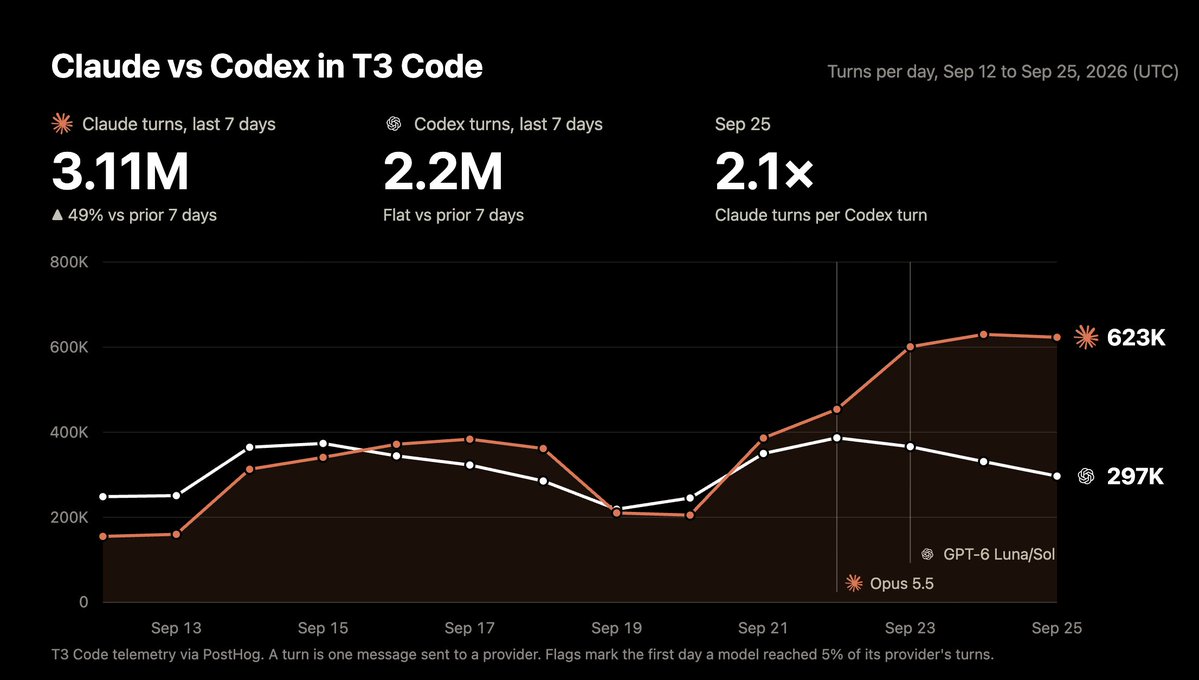
Summary: @theo posted T3 Code usage charts: two weeks ago Codex led; today Claude is about 2× more popular. A follow-up shows seven days of usage and notes you can run hard with roughly two Claude subs plus one Codex sub. In the Chinese timeline, @tualatrix quipped that “量大管饱” (generous quotas) used to describe ChatGPT/Codex and now fits Claude.
Why it matters: Default-tool flips usually track friction and quota feel more than leaderboard deltas.
- Popularity flip: https://x.com/theo/status/2103704797237096741
- Seven-day usage: https://x.com/theo/status/2103794887481319566
- Quota joke: https://x.com/tualatrix/status/2103746764847333409
3. Jev Router: a $1,000 bake-off vs GPT-6 Astra
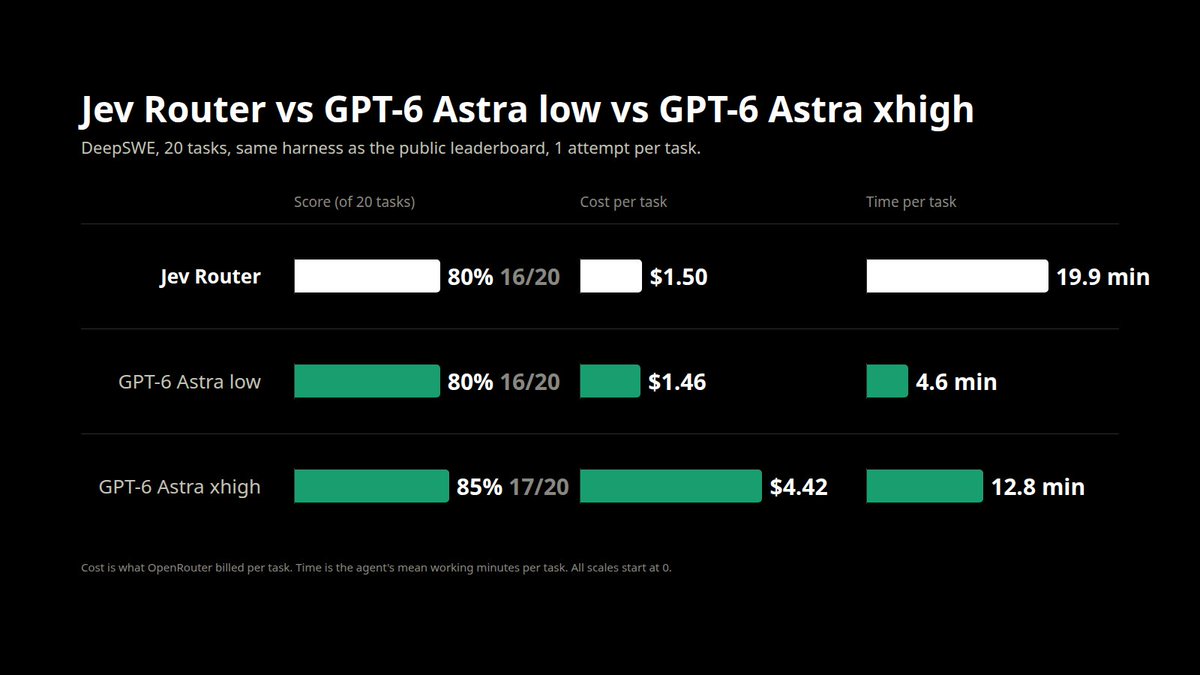
Summary: @OpenRouter introduced typesafe/jev-router, a cache-aware router powered by Jev that picks model and reasoning effort per request. @theo stayed up until 2am and spent about $1,000 benchmarking it on DeepSWE: performance roughly matched GPT-6 Astra on low, at slightly higher cost and nearly 5× runtime. He separately stressed that he likes Jev a lot — he’s just tired of people forcing it into jobs it isn’t good at.
Why it matters: Once System One “decision/classification” models sit in the router, the debate becomes whether they should choose your frontier coding model for you.
- Benchmark: https://x.com/theo/status/2103774771788108008
- Scope clarification: https://x.com/theo/status/2103927696359358744
4. OpenCode: it’s the harness, not the model
Summary: Quoting a one-shot demo, @thdxr insisted it only works in opencode — it’s harness engineering end-to-end, not the underlying model.
Why it matters: Same-day resonance with Jev and the minimal-harness paper: the “shell” is increasingly treated as the product.
5. Cline: Pixel Canary (stealth) free
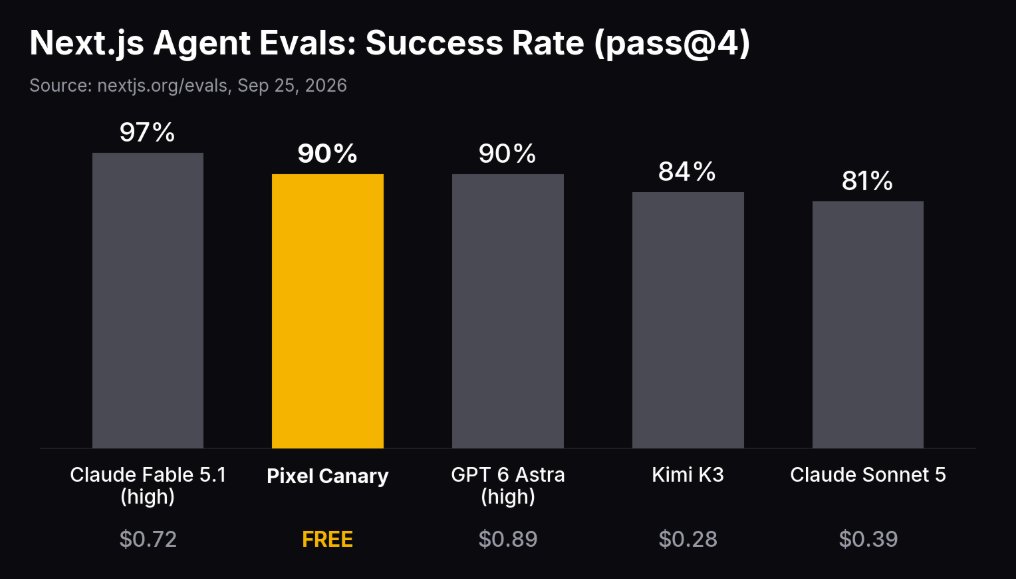
Summary: @cline announced stealth model Pixel Canary, free in Cline. On Next.js Agent Evals (real Next.js web/mobile tasks) it ties GPT-6 Astra and beats Kimi K3. A sibling post pushed how fast it feels in the new Cline Desktop app alongside other free-model promos.
Why it matters: Independent harnesses keep competing with free stealth models plus task-shaped evals.
- Launch: https://x.com/cline/status/2103636639038026093
- Desktop speed: https://x.com/cline/status/2103636640715690479
6. OpenClaw: Autopilot — and Microsoft contributing back
Summary: @openclaw followed Microsoft’s Autopilot (always-on agent built on OpenClaw) news by spotlighting how much @OmarShahine and others at Microsoft have contributed back to OpenClaw, with a link detailing those contributions.
Why it matters: Whether a big-vendor stack on an open agent runtime actually feeds the upstream decides if the partnership is reusable infrastructure or a one-off wrap.
7. Opus 5.5: more asm speedups + quota efficiency vibes
Summary: @dhh said Opus pushed the Omarchy screensaver engine further overnight — up to about 22× peak / 6× mean, and up to ~450× vs the original Python — with SSE2/AVX2/AVX-512 paths. @signulll asked how Opus 5.5 got this efficient: few limit hits, strong on hard problems, and dramatically better capability-per-token feel than Astra/Sol. A separate viral take argued that with full company-tool access plus computer-use loops, Opus 5.5 already covers most white-collar work.
Why it matters: Model discourse is advancing on two axes at once: drilling closer to the metal, and how far a quota goes.
- Further speedups: https://x.com/dhh/status/2103745963089092975
- Quota efficiency: https://x.com/signulll/status/2103974381219196937
- Tool-access take: https://x.com/signulll/status/2103901199774683144
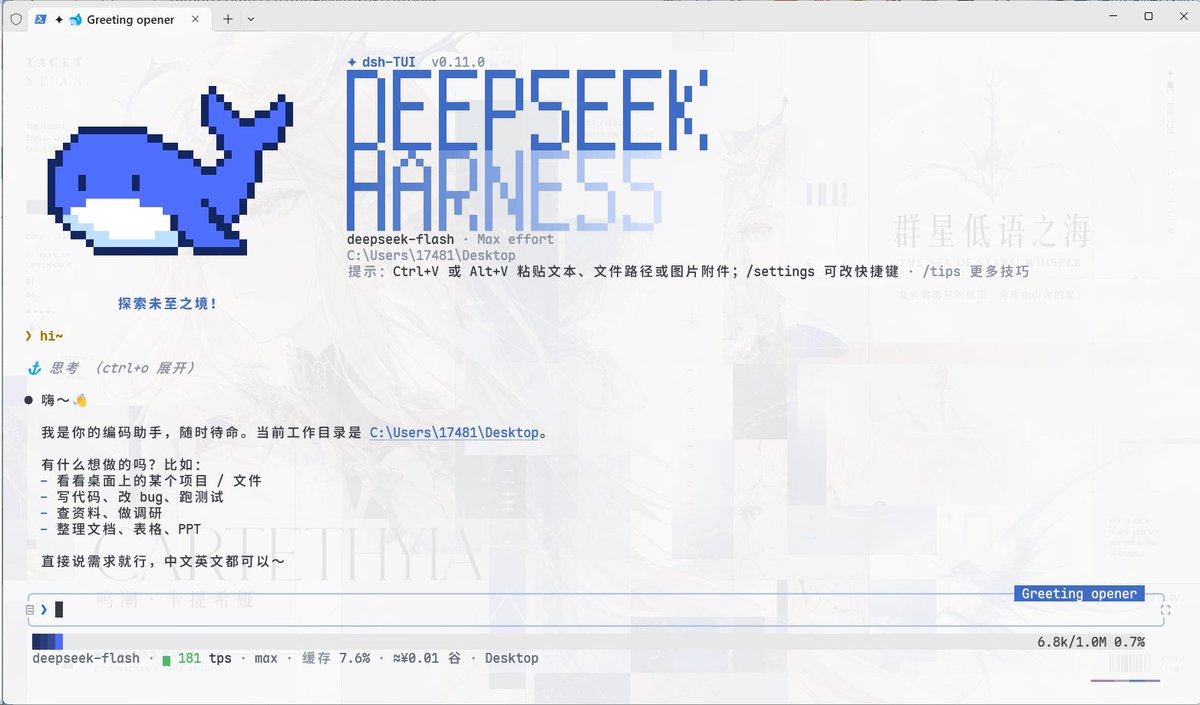
8. DeepSeek Harness: community plugin dsh-TUI
Summary: @tianyi continued the DSH plugin spotlight series with dsh-TUI, a carefully maintained TUI that fills a gap in DeepSeek Harness and tracks DSH releases — continuing the earlier “~60% of users run at least one third-party plugin” storyline from DeepSeek’s API-side stats.
Why it matters: Domestic harnesses are treating plugin ecosystems as a first-class product surface, not just a model skin.
9. OmO v5 (pi / senpi) ships stable
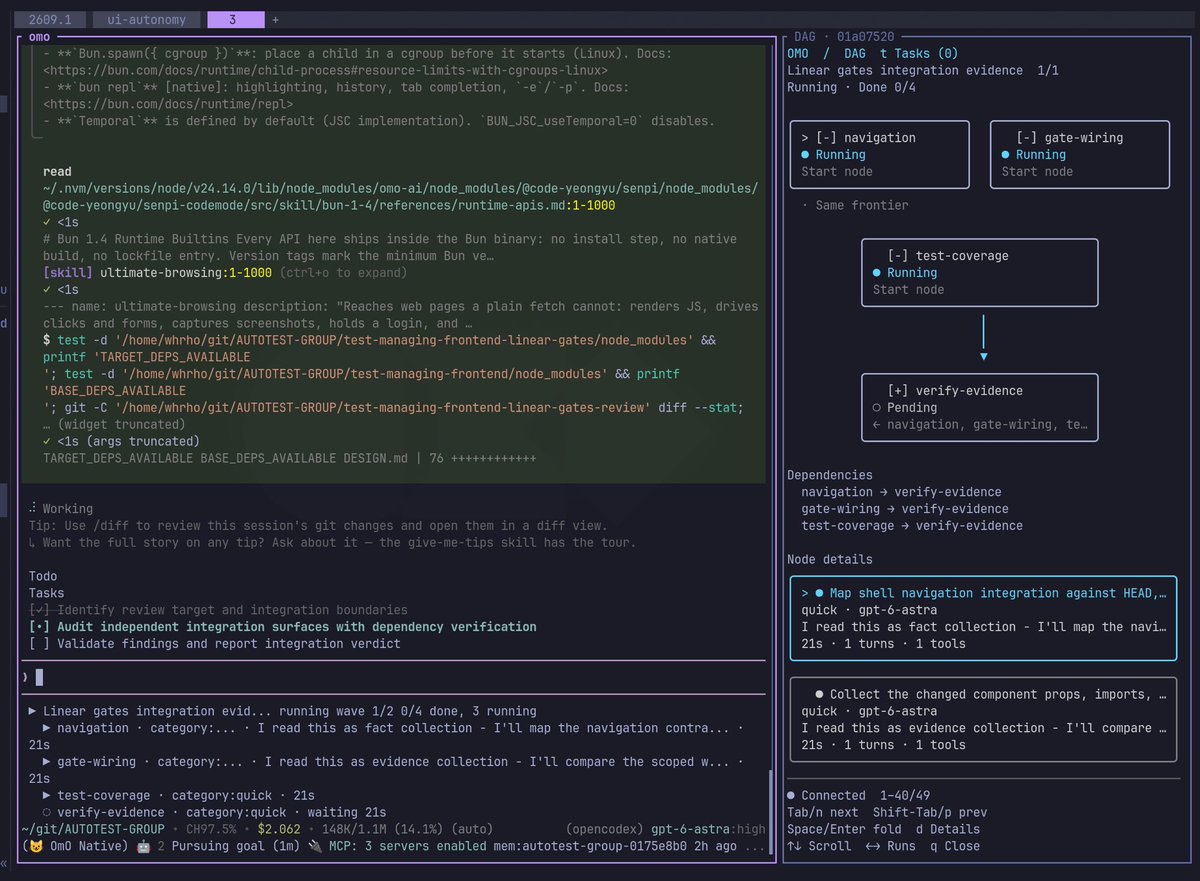
Summary: @justsisyphus announced pi-based OmO v5: ~10× faster tool calls via codemode, an aha-like dual-agent memory loop, better ultracode mixing Astra/Opus, and improved visualization; install via bun install -g omo-ai. npm omo-ai@5.0.0 and GitHub oh-my-openagent v5.0.0 landed on the stable channel the same day (after a long beta line).
Why it matters: The pi-family harness moves from “beta forever” to a default-installable stable release, still betting on multi-model workflows.
- Launch: https://x.com/justsisyphus/status/2103923201055289369
- Install notes: https://x.com/justsisyphus/status/2103923205014753326
10. MIT CSAIL: JAZ — a one-primitive harness
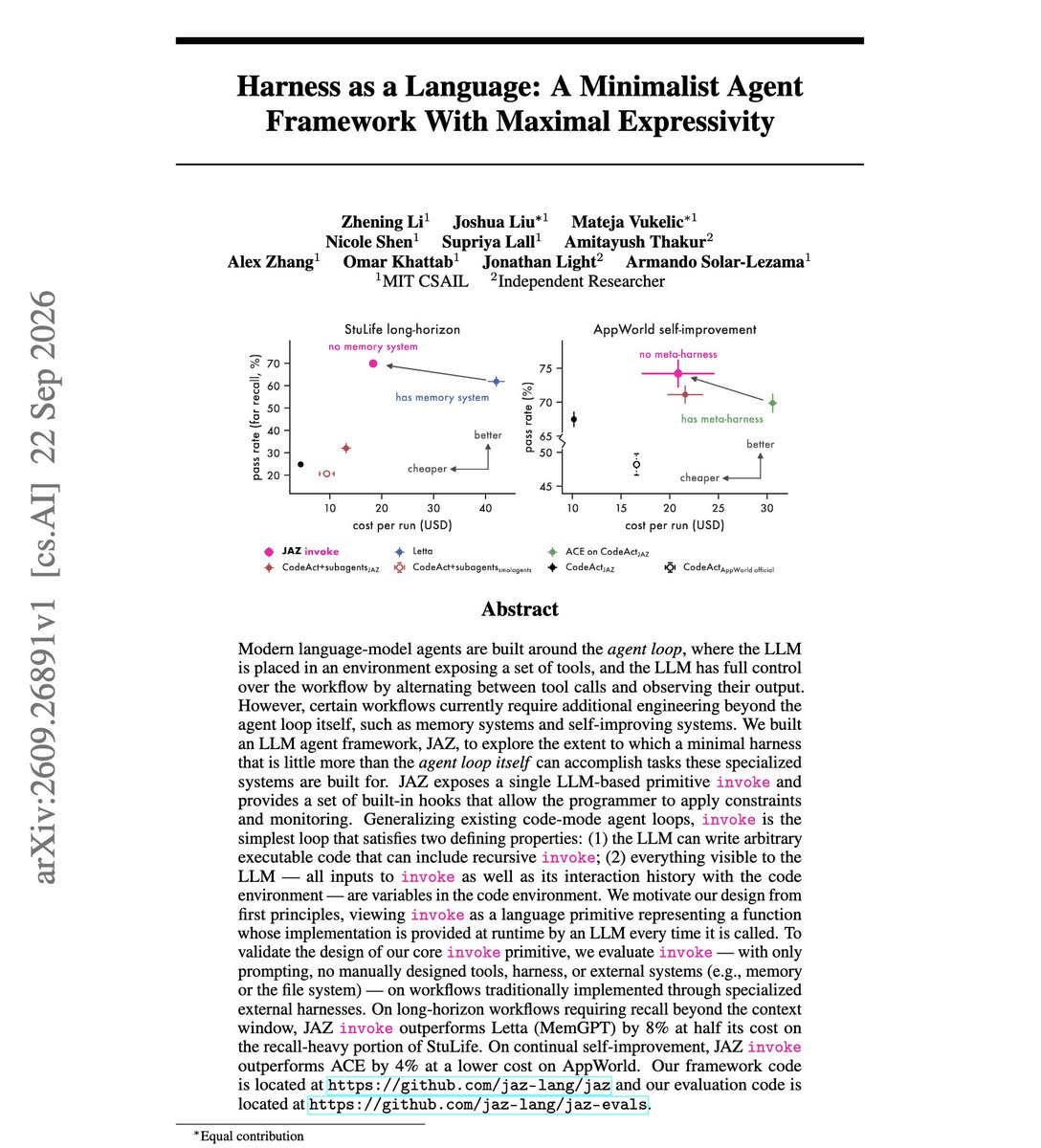
Summary: @omarsar0 highlighted the MIT CSAIL paper Harness as a Language: JAZ exposes a single primitive, invoke — the LLM writes code, may recursively invoke, and sees all inputs/history as variables in the code environment. With prompting only (no separate memory subsystem), they report ~+8% vs Letta (MemGPT) at about half the cost on the recall-heavy StuLife slice, and ~+4% vs ACE at lower cost on AppWorld. The paper hit arXiv around Sep 22; code lives at jaz-lang/jaz (the repo is older — this is paper-discussion heat, not a same-day “just open-sourced” event).
Why it matters: Same-day counterpoint to “thicker harness wins”: sometimes the thinnest loop still covers long-horizon recall and self-improvement.