Today's Highlights
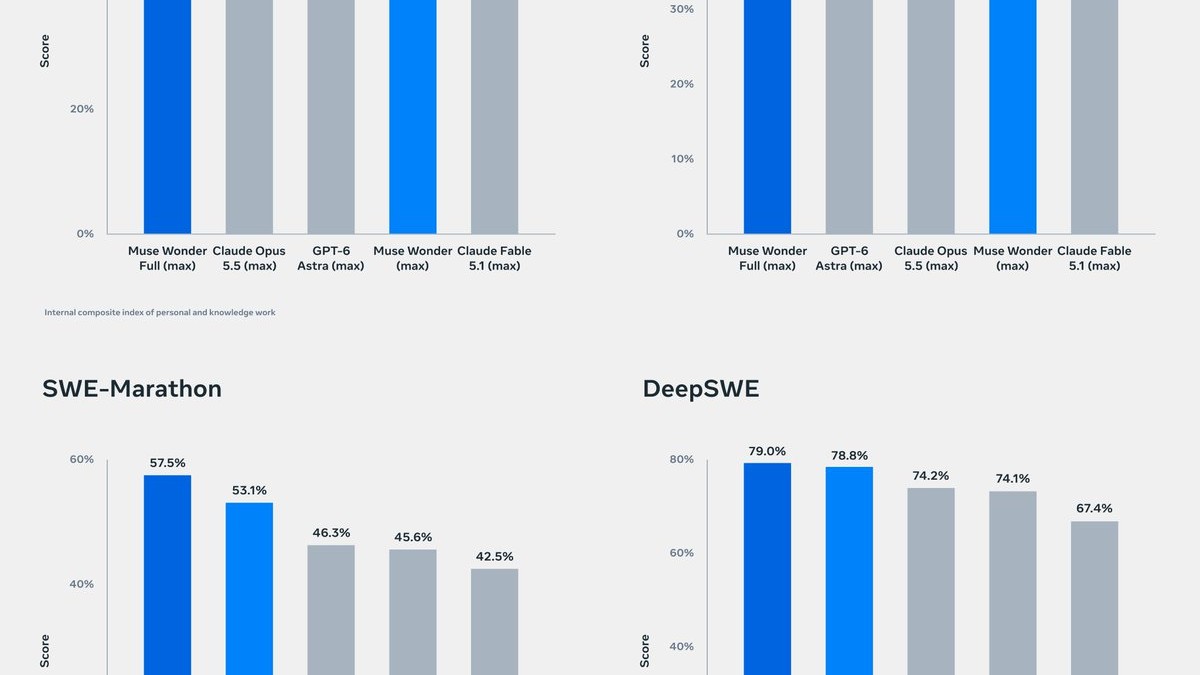
- Meta ships Muse Wonder: @finkd and @alexandr_wang launched a frontier family aimed at personal / professional agents; @theo put Muse Wonder Full next to Opus 5.5 in S, and stressed that API Wonder is “significantly worse” than subscriber Full.
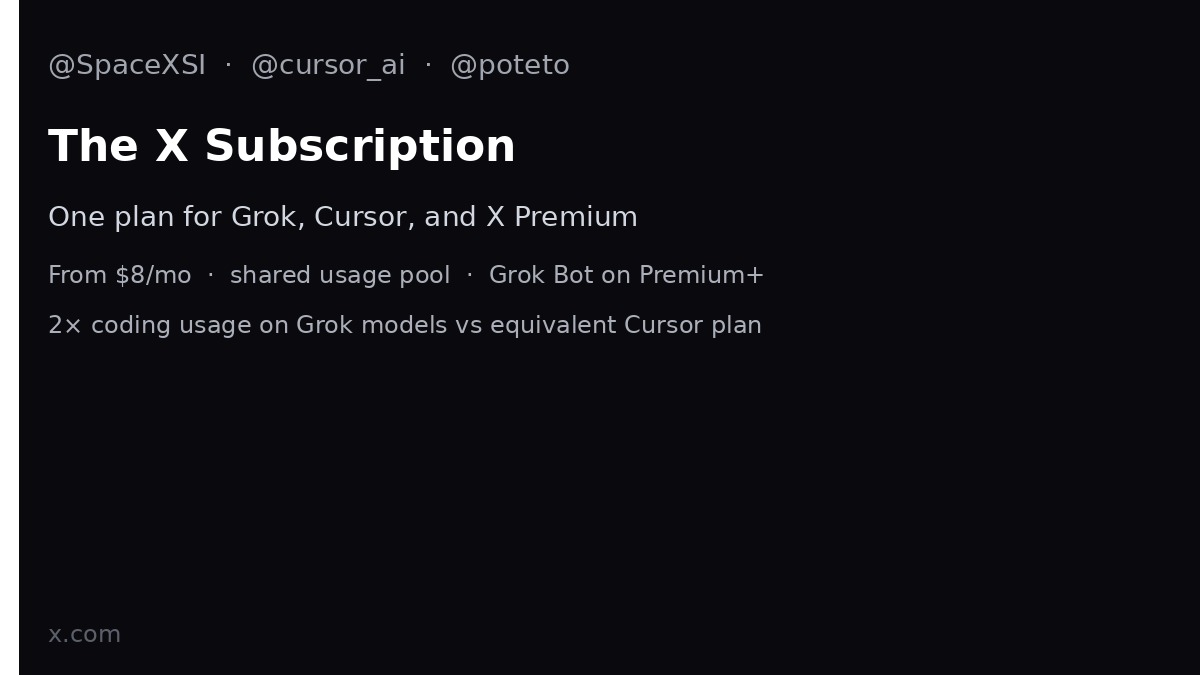
- The X Subscription folds Cursor into Grok / X Premium: @SpaceXSI, @cursor_ai, and @poteto announced the same day — paid tiers share one usage pool, Premium+ includes Grok Bot, Grok coding usage is 2× the equivalent Cursor plan, entry around $8/mo.
- OpenCode 2.0 and “Bot as brain, coding agent as hands” heat up together: official rewrite of background Service / API / Code Mode; @Gorden_Sun shared calling cloud Grok Bot via native API to skip video / X API bills; @poteto pinned verification as the entry to more correct agent code.
1. Muse Wonder: Meta puts an agent model in S-tier
Key points: @finkd introduced Muse Wonder — a new frontier family for personal and professional agentic work; @alexandr_wang followed with eval framing against top agent / coding models and a comparison chart. The loudest community read came from @theo: model board S = Opus 5.5 + Muse Wonder, then a gap to GPT-6.1 Sol; he later clarified he meant Wonder Full (subscriber), while API Wonder is “significantly worse,” and both the naming and Full-only restriction annoy him. He also said last week’s hard Muse push in T3 Code was so Opus can ask Wonder for code / architecture review.
Why it matters: Not another “we have a model too” press note — Zuckerberg posts, Alexandr posts evals, theo rewrites the board. First time Meta lands in S for coding / personal-agent users in the open.
- Zuckerberg: Introducing Muse Wonder: https://x.com/finkd/status/2109689305073614918
- Alexandr: evals and positioning: https://x.com/alexandr_wang/status/2109691967676563613
- theo: S-tier board: https://x.com/theo/status/2109724741234028639
- theo: Full ≠ API Wonder: https://x.com/theo/status/2109784568672985520
2. The X Subscription: Grok, Cursor, and X Premium on one bill
Key points: @SpaceXSI announced The X Subscription — Grok, Cursor, and X Premium under one plan. @cursor_ai spelled out the details: current Cursor subscribers can keep their plan or switch; paid tiers share one usage pool across Cursor, Grok Build, and other Grok products, with twice the coding usage on Grok models versus the equivalent Cursor plan; Premium / Super / Ultra include Grok Bot; third-party models in Cursor move to API pricing on the new plans to make room for Grok usage. @grok said entry is about $8/mo across five tiers; @poteto quote-tweeted “it’s finally here.”
Why it matters: Yesterday was “hire Bot as an employee”; today the IDE subscription lands on the same invoice — how quota splits and how third-party models are billed will hit daily model choices immediately.
- SpaceXSI: unified subscription: https://x.com/SpaceXSI/status/2109783335296008414
- Cursor: details: https://x.com/cursor_ai/status/2109783879490191502
- poteto: finally here: https://x.com/poteto/status/2109784281916878885
- Grok: from $8: https://x.com/grok/status/2109783860636500318
3. OpenCode 2.0: background Service, Code Mode, background subagents
Key points: @opencode shipped OpenCode 2.0: the client/server Service now runs by default as one background process; TUI / web / desktop / @opencode/client all talk to it; API rewritten from scratch; Code Mode turns MCP / OpenAPI into scriptable functions so agents can list → map → call in one round trip; background subagents and async shell; plugins forced almost every 2.0 feature through an internal plugin surface (80+), with mid-session hot reload. Upgrade path: opencode upgrade --major after latest 1.x. Same day: Operation Cheepseek Phase 3 — $80 of DeepSeek V4.1 Flash usage. Repo anomalyco/opencode was created 2025-04; today’s spike is the major release.
Why it matters: Open-source coding agents move from “chat and edit files” to “resident service + programmable tool surface” — same orchestration direction as Claude Mods / T3, but on a self-hostable protocol.
- OpenCode 2.0: https://x.com/opencode/status/2109649032931119362
- Cheepseek Phase 3: $80: https://x.com/opencode/status/2109573342584058065
4. poteto: correctness before “Good” — verification is the entrypoint
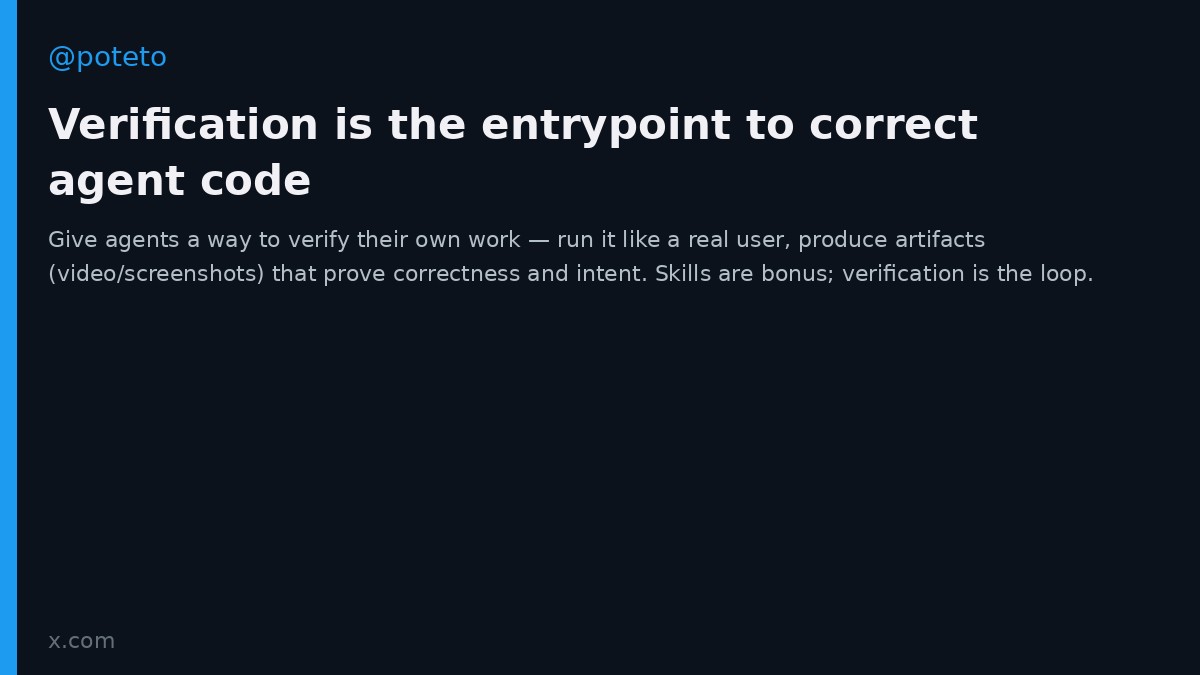
Key points: After yesterday’s Good Code / clean-code fight, @poteto steered to something more practical: how to get agents to write more correct code (not necessarily Good — at least working). Her answer is the entry to the basic agentic loop — verification: give the agent a way to verify its own work, most often by running and interacting like a real user (CLI / API / UI); TLA+ for state-machine bugs is fair game. Produce artifacts easier to review than a whole PR (video, screenshots) that prove correct, intended, and reviewable. Skill packs are optional bonus; without a verification loop you don’t get more autonomy. The post cleared three thousand bookmarks.
Why it matters: Next chapter after “do we still pay for human-readable elegance?” — weld “runs and can prove it” into the workflow before arguing about style tax.
- poteto: verification entrypoint: https://x.com/poteto/status/2109436202554372476
5. Grok Bot native API: let Codex / Claude Code call the cloud Bot
Key points: @Gorden_Sun shared a “top usage”: Grok Bot has a native API, so other agents can call the cloud Bot for video generation / X search and skip separate video / X API bills; the API is created in the Cursor backend (he stresses Grok Bot is effectively Cursor Bot); file exchange with the cloud Bot can go through Cloudflare R2 or a private GitHub repo. Contrast: Gemini Spark, Muse, and Dots lack official API/MCP, so people reverse CLIs and risk bans. Heavy CN/EN recirculation; 200+ bookmarks.
Why it matters: Moves “Bot as coworker” from chat habit to a programmable dependency — people whose daily driver is still Codex / Claude Code get an official cloud pair of hands.
- Gorden_Sun: native API tip: https://x.com/Gorden_Sun/status/2109508218288513335
6. Bot as orchestrator: search, automations, Cursor Cloud all through it
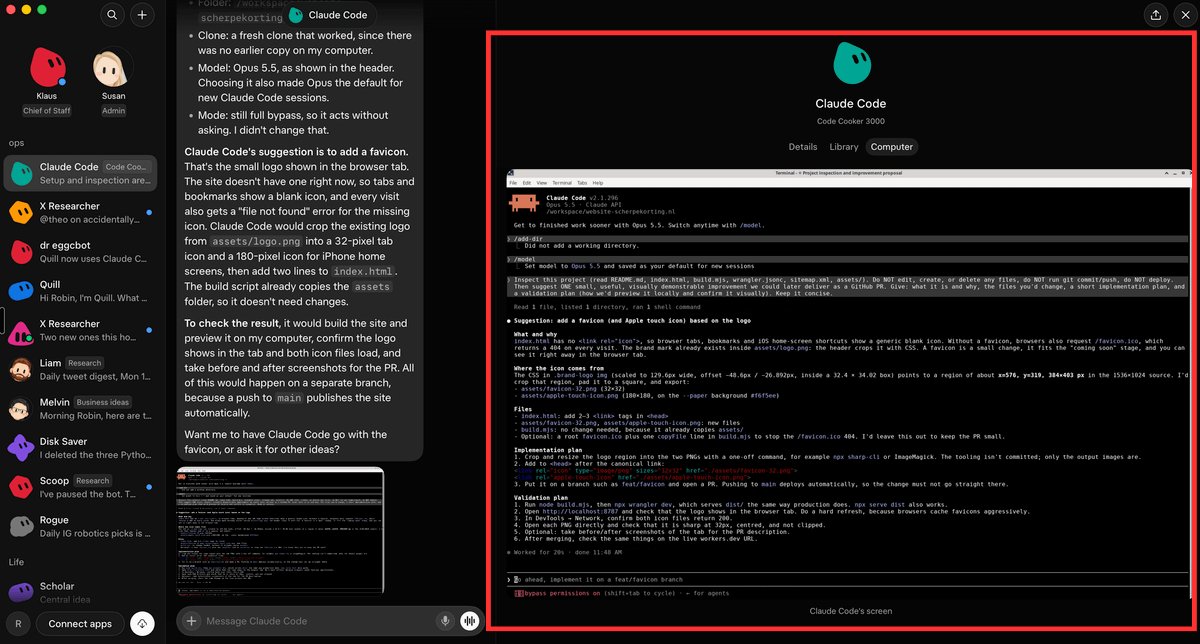
Key points: @emigal wrote that after a few weeks with Grok Bot as daily driver it has replaced 100% of his ChatGPT/Claude search-like queries, 100% of Hermes usage & automations, and 100% of his Cursor cloud agents (PR review, merges); the VM is on Tailscale with SSH to all machines, can spawn Claude Code / Codex in the terminal, and can create more bots on the fly for the main Bot to manage. @melvindvivas noted people using Bot as orchestrator for Claude Code / Codex / Hermes to hand off coding without burning Bot limits; @heyrobinai posted a copyable “install Claude Code on the Bot’s computer” setup.
Why it matters: Narrative shifts from “Bot can get things done” to “Bot is the topology center” — brain in the cloud, hands in local harnesses, quotas split deliberately.
- emigal: daily driver: https://x.com/emigal/status/2109672788264910948
- melvin: Bot as orchestrator: https://x.com/melvindvivas/status/2109485274661331013
- heyrobinai: Claude Code on Bot: https://x.com/heyrobinai/status/2109621421244821962
7. Yobiru.com ships: cross-machine agent wake-ups get a homepage
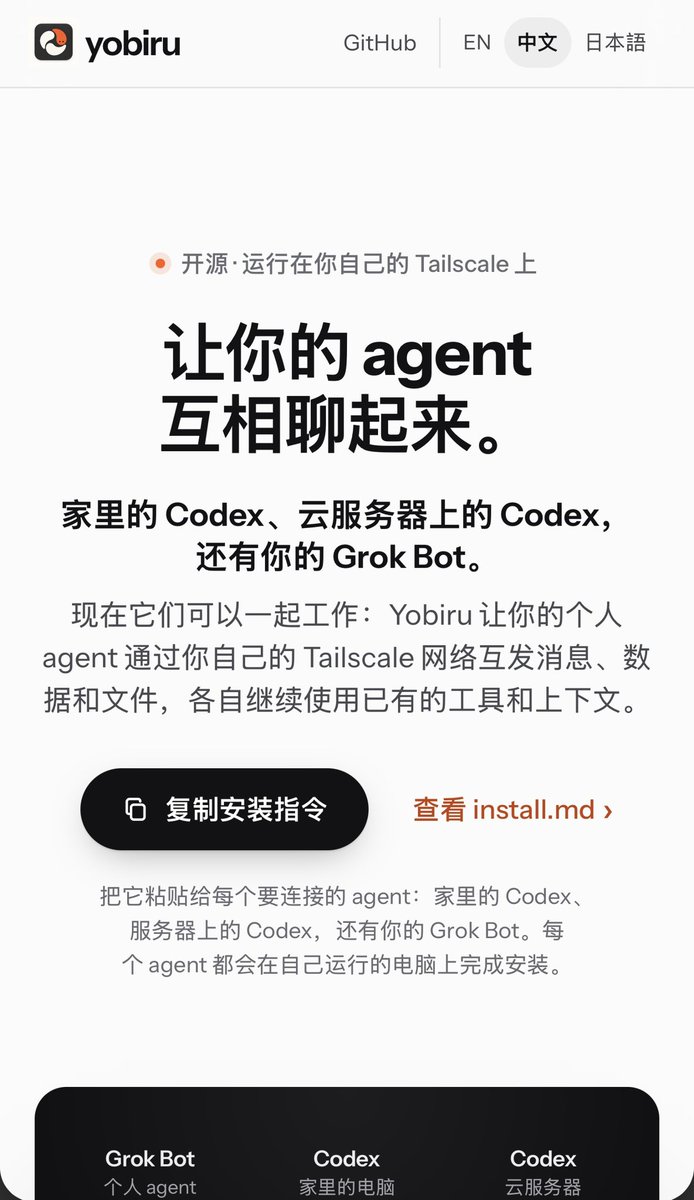
Key points: After yesterday’s open-source drop, @turingou launched yobiru.com with a full walkthrough: Grok Bot handles X / life chores, home-Mac Codex drives WeChat and 3D tools, Tokyo-server Codex/Claude Code writes code — previously glued by human copy-paste; now they address each other by machine/agent name over your own Tailscale, exchanging text, JSON, and files (SHA-256 checks), with replies returning to the originator. A second post added idle phones / an iPad into Codex’s iPhone Use matrix so Dots / Grokbot can drive local Codex. Repo was already verified as recently created; today’s spike is the site + usage story.
Why it matters: After “we open-sourced it,” what’s missing is “install and follow along.” A homepage plus a real topology turns cross-machine wake-ups from a script into a forwardable product page.
- turingou: Yobiru site: https://x.com/turingou/status/2109643779464720568
- turingou: iPhone Use matrix: https://x.com/turingou/status/2109575273545150472
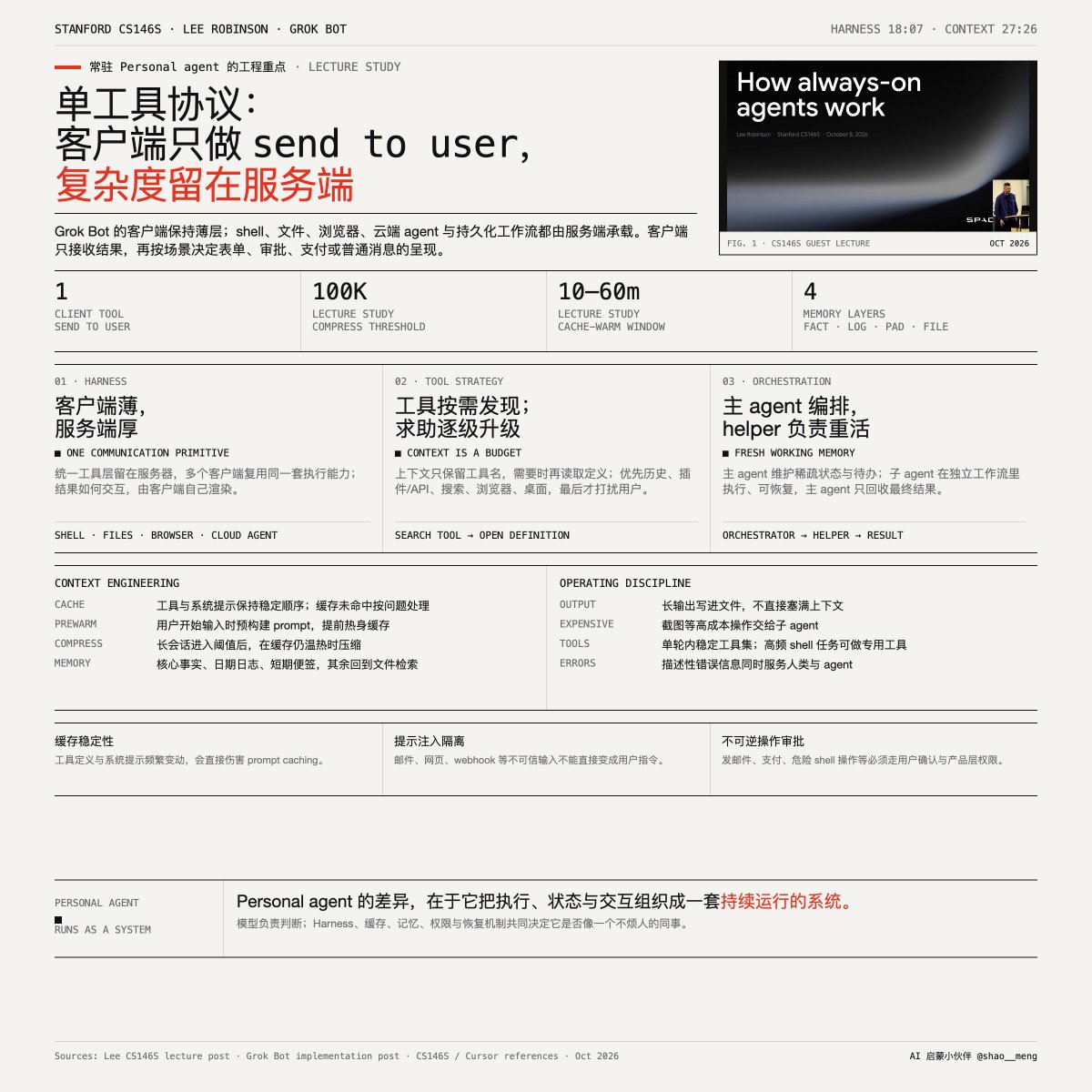
8. Lee Robinson lecture notes: Grok Bot harness and context engineering
Key points: @shao__meng distilled Stanford CS146S notes from Lee Robinson on how Grok Bot / Muse-style personal agents differ from coding agents. Harness: almost a single client↔server primitive — send to user — with heavy tools living server-side; dynamic tool discovery keeps only tool names in context; an escalation ladder from session history → plugins/APIs → search → browser → full desktop before bothering the human; lead agent orchestrates, helpers persist via Temporal. Context: prompt caching with static ordering, compress while the cache is still warm, four memory layers (core facts / dated logs / scratchpad / file grep).
Why it matters: Yesterday people shared Bot use cases; today they unpack “why it bothers you less” — more valuable than another feature list if you’re building a harness.
- shao_meng: harness notes: https://x.com/shao_meng/status/2109493115421954200
9. Claude Code: describe a annoyance, let it write its own mod
Key points: @Pashoke1 showed Claude Code’s built-in plugin-authoring skill: one sentence describing the annoyance writes a mod into ~/.claude/dev-mods/, hot-reloads into the session, then claude plugin validate lists hooked events and network calls; copy the folder out before the session cleans up and reload later with --plugin-dir. A companion article lists 9 mods worth installing plus DIY prompts. Next step after Mods shipped — not only install others’ plugins, but let the harness rewrite itself live.
Why it matters: After Hooks / Skills / Mods, “one-sentence plugin” drops customization to chat level — and every hot-reload path should be reviewed like a supply-chain dep.
- Pashoke1: one-sentence self-mod: https://x.com/Pashoke1/status/2109673037440196643
- Pashoke1: 9-mod guide: https://x.com/Pashoke1/status/2109545339451589034
10. T3 Code: “update everything” + Muse-ready orchestration
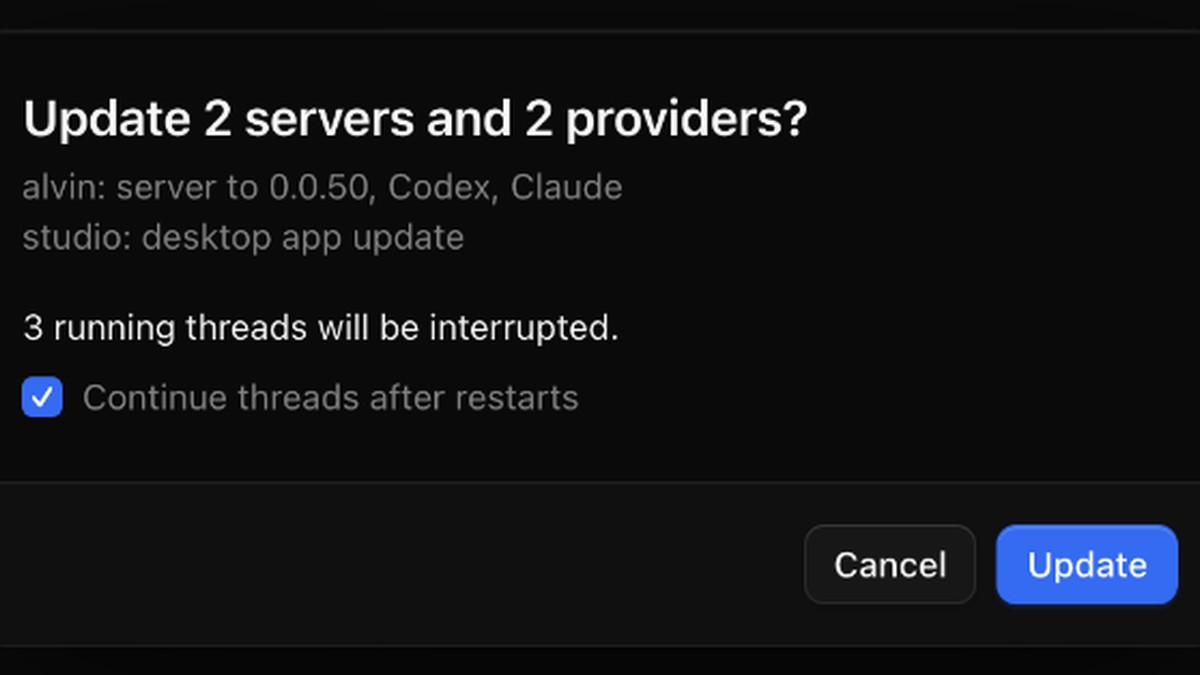
Key points: @theo shipped an Update everything button on T3 Code nightly: one click updates the local app, T3 Code across environments, providers (Claude Code, Codex, etc.) across environments, then resumes threads. Paired with putting Muse Wonder Full in S-tier and saying Orchestrator V2 often has Opus ask Wonder for review — T3 is pushing on both ops friction and multi-model orchestration.
Why it matters: Multi-machine, multi-provider pain is often version drift; once everything is aligned, Opus / Wonder / Sol can actually share one control plane.
- theo: Update everything: https://x.com/theo/status/2109560164739350856
- theo: Wonder in Orchestrator: https://x.com/theo/status/2109731846842196093