AI Twitter Highlights · 2026-09-21
AI Twitter/X Highlights Digest · 2026-09-21 (Mon)
Key Takeaways
- Jev drops the waitlist for everyone; open Kev decision models and DocJev land the same day.
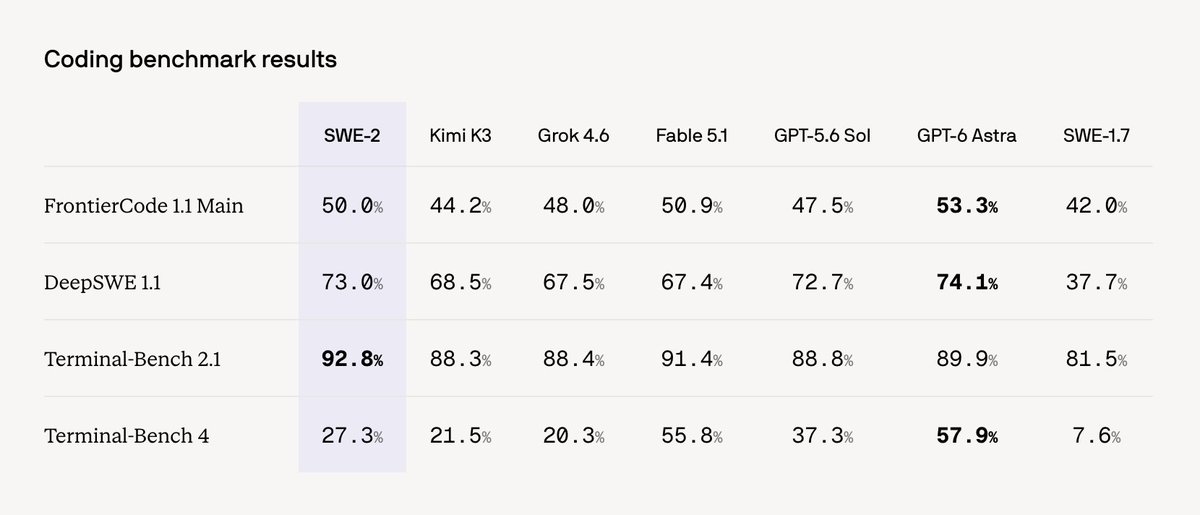
- Claude Code’s official “spend fewer tokens” workshop goes viral in JP; Devin keeps free SWE-2 in Cloud plus Fusion chatter.
- Cline Desktop hits ~6% of all tasks one week in; Codex $200 angst meets Cloudflare’s hot security-audit-skill.
- A UC Berkeley-led look at Harness Tax: swap shells, similar success rates, up to ~5× cost—minimal Pi wins on spend.
1. Jev: no waitlist, open to everyone
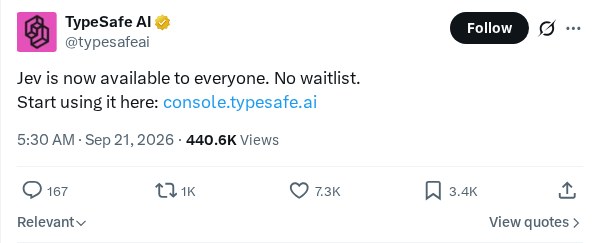
Summary: @typesafeai announced Jev is available to everyone—no waitlist. The same day, @omarsar0 shipped an auto-updating Awesome Jev Collection and an interactive Jev Primer & Playground, with curation powered by Jev itself.
Why it matters: Classifiers move from invite-only novelty to a default agent decision primitive—the conversation shifts from access to integration.
- Open access: https://x.com/typesafeai/status/2101786156572823624
- Awesome Collection: https://x.com/omarsar0/status/2101696753749655863
- Primer & Playground: https://x.com/omarsar0/status/2101775584661573692
2. Kev: open-source Jev-like decision models you can train
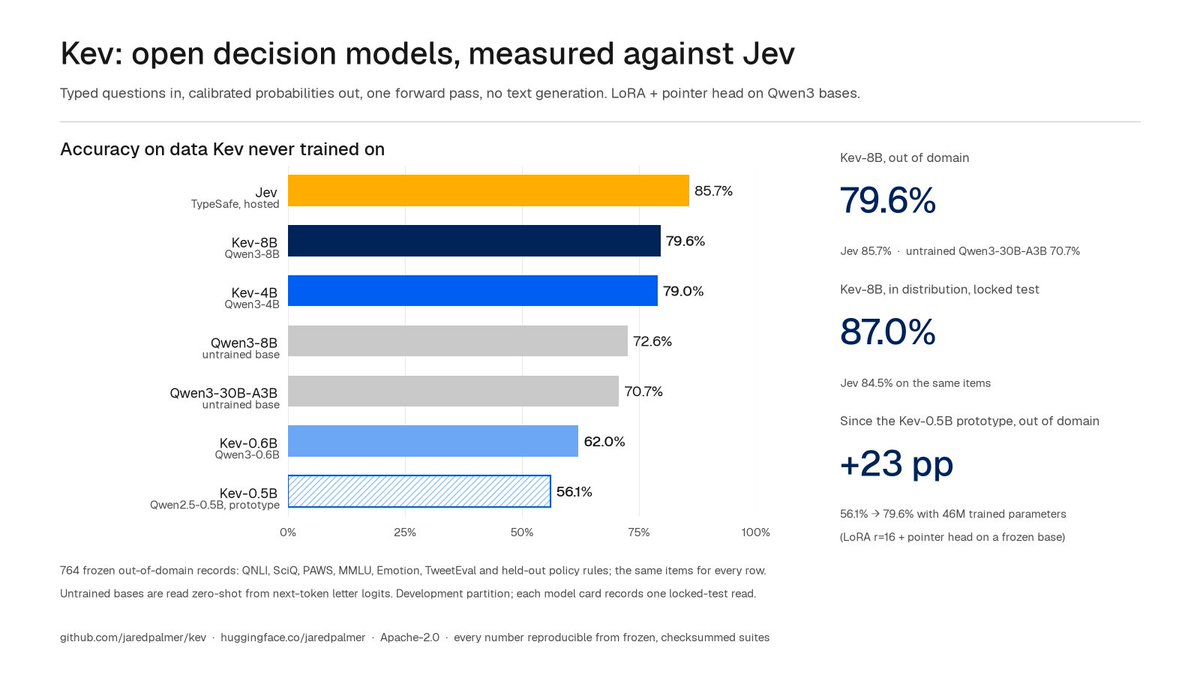
Summary: @jaredpalmer updated Kev-0.6B / 4B / 8B—open (Apache 2.0) Jev-style decision models on Qwen3. Out-of-domain: Kev-8B ~79.6% vs Jev 85.7%. Kev-4B runs five questions in ~300 ms bf16 on a 32 GB Mac; TypeSafe System One SDK works with a base_url swap.
Why it matters: The day Jev opens the gate, a train-it-yourself open alternative appears for the same decision-head niche.
3. DocJev: document classify & split with Jev
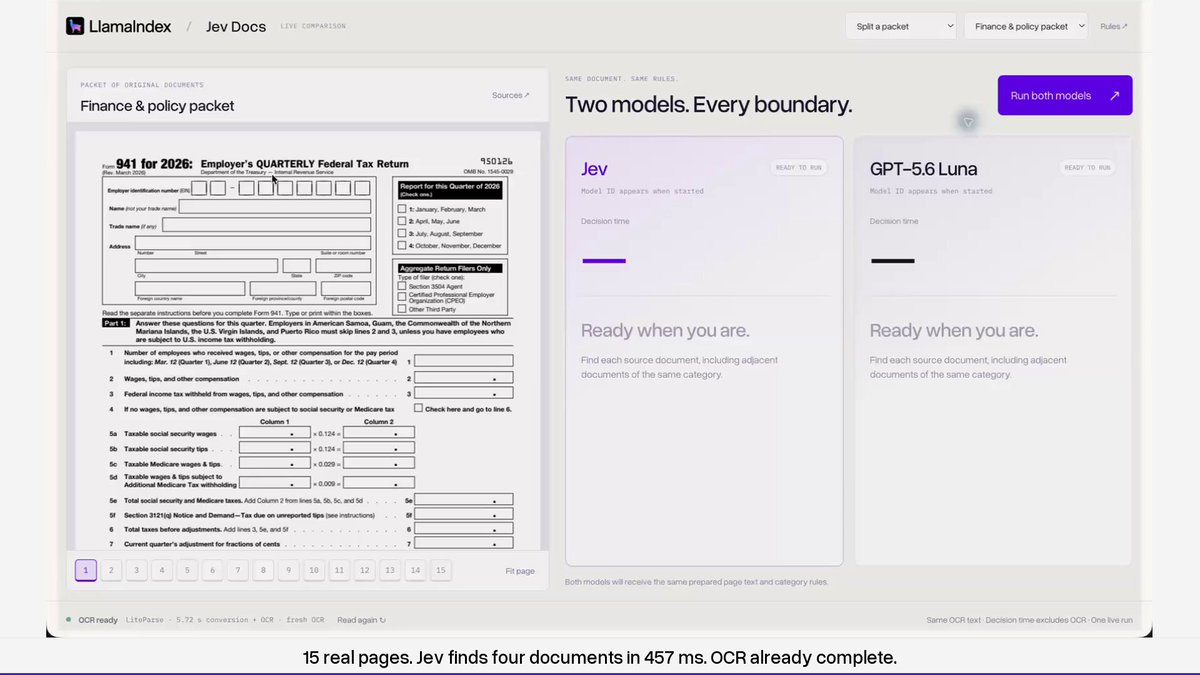
Summary: LlamaIndex’s @jerryjliu0 launched open-source DocJev: feed a document plus natural-language category rules; Jev classifies or finds sub-document boundaries. Claims ~6× faster than gpt-5.6-luna at similar accuracy. OCR via liteparse (fast) or LlamaParse (complex layouts).
Why it matters: Decision models land in the ingestion path—not just chat routing.
4. Claude Code: official token-saving workshop + JP skills
Summary: @ClaudeCode_love amplified Anthropic’s ~26-minute Claude Code token workshop: /clear between tasks, route Haiku/Sonnet/Opus/Fable by job, disable idle MCP with /mcp, farm heavy research to sub-agents, and enable telemetry for cache hit rate and per-person cost. @minorun365 also open-sourced a Skill for building talk decks with Claude Code.
Why it matters: Official guidance on not burning context—often more useful than another model SKU.
- Workshop: https://x.com/ClaudeCode_love/status/2101538091668484599
- Deck Skill: https://x.com/minorun365/status/2101672853443957238
5. Devin: free SWE-2 in Cloud + Fusion + macOS teardown
Summary: @dabit3 noted SWE-2 remains free in Devin Cloud Agents / CLI / Desktop through Oct 8 on paid plans, and argued multi-model Fusion harnesses are the future. @b_shulha tried Fusion (Fable + SWE-2) and called it a rare auto-mode with real WOW. @LinearUncle highlighted Cognition engineer Jon’s Bringing macOS to Devin—EC2 Mac, Virtualization.framework, accessibility-tree CLI, and computer use.
Why it matters: Free-flagship window, multi-model orchestration, and cloud Mac engineering details all in one feed day.
- Free SWE-2: https://x.com/dabit3/status/2101684714318778414
- Fusion future: https://x.com/dabit3/status/2101714747733254512
- Fusion hands-on: https://x.com/b_shulha/status/2101653743007629778
- macOS teardown: https://x.com/LinearUncle/status/2101582102588502096
6. Cline Desktop: ~6% of tasks after one week
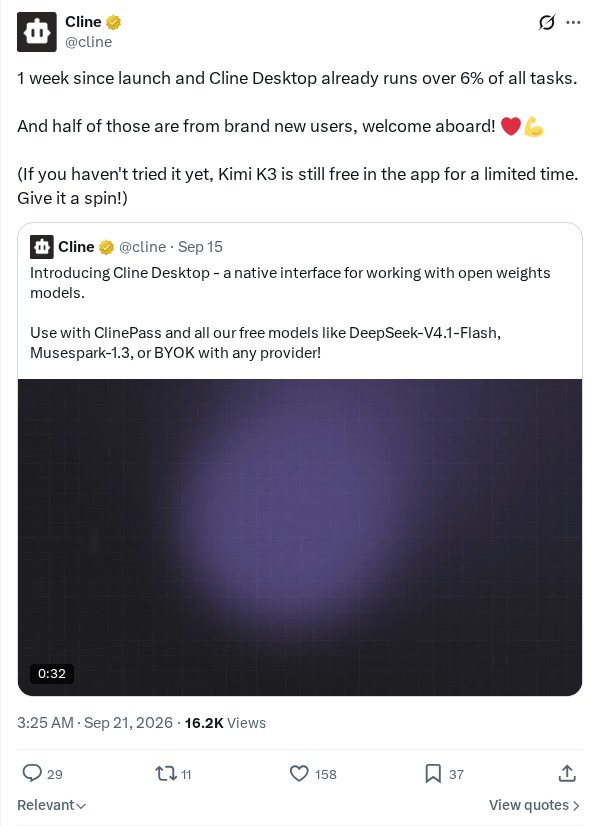
Summary: @cline said Cline Desktop already runs over 6% of all tasks one week after launch, with about half from brand-new users; Kimi K3 remains free in-app for a limited time.
Why it matters: Desktop traction measured in real task share, not another changelog bullet.
7. Codex: subscription angst + Cloudflare security-audit-skill trending
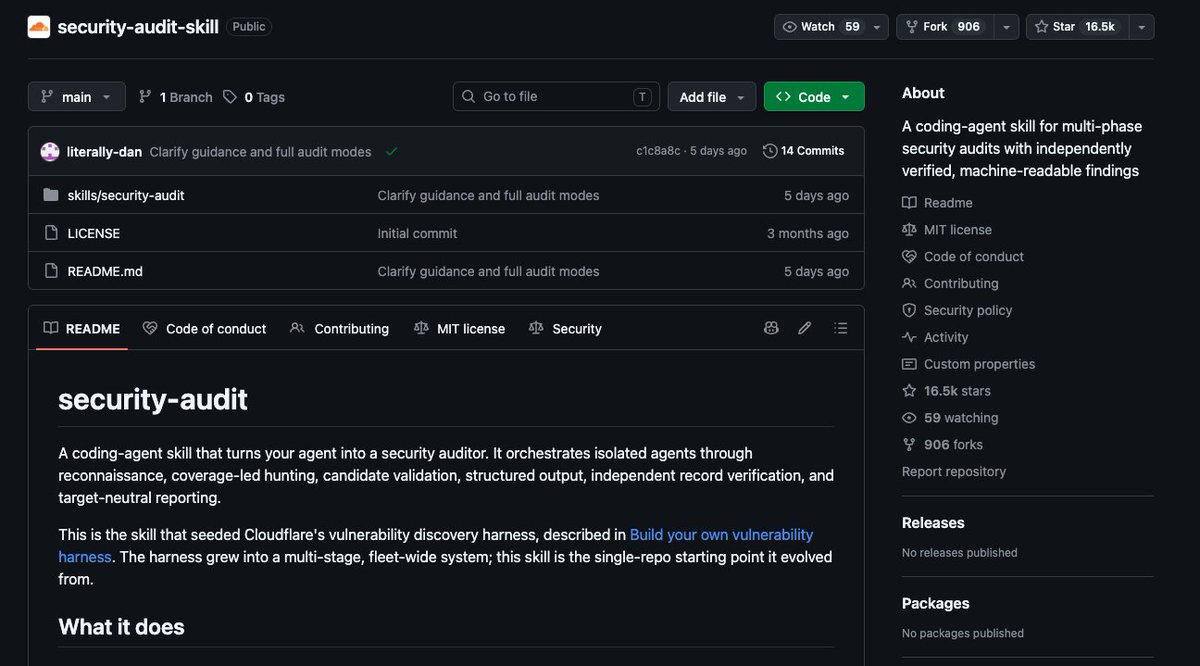
Summary: @haydendevs floated canceling a $200 Codex sub for open models—“can’t justify paying for something I only use a few times a month.” Separately @huhuhang pointed surplus Codex quota at GitHub Trending #1 cloudflare/security-audit-skill. The repo was created 2026-06—today’s spike is recirculation, not a brand-new open-source drop.
Why it matters: Same product line, two fights at once: is it worth it, and where should spare quota go.
- Subscription take: https://x.com/haydendevs/status/2101718661945823336
- security-audit-skill: https://x.com/huhuhang/status/2101502764484624813
8. Harness Tax: similar success, up to ~5× cost
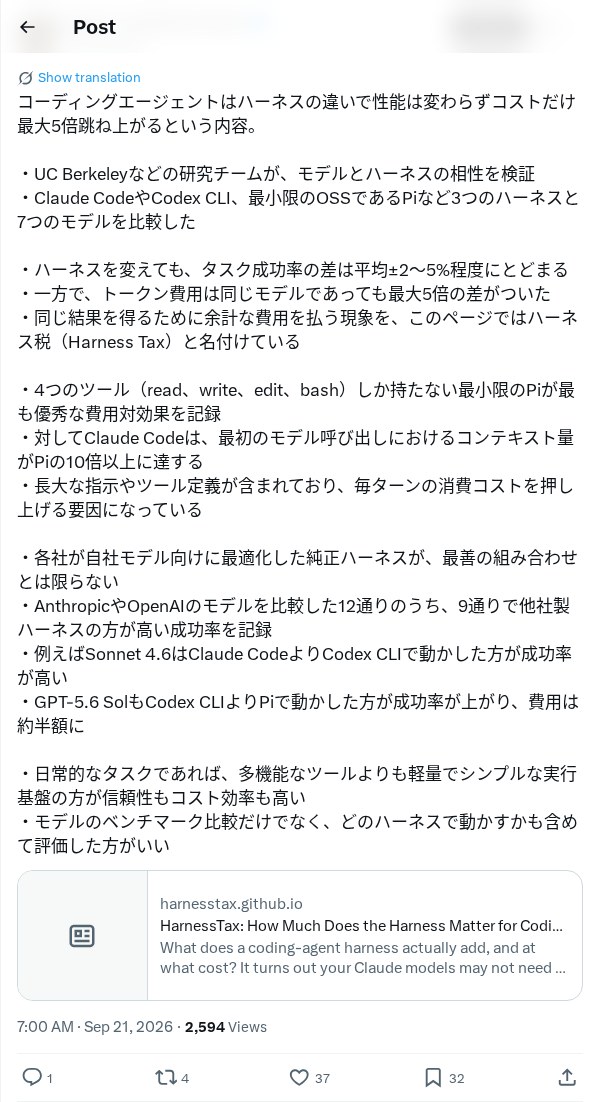
Summary: @iwashi86 summarized UC Berkeley-led work across Claude Code, Codex CLI, and minimal OSS Pi with seven models: swapping harnesses moves success rates only ~±2–5% on average, while token cost for the same model can differ by up to ~5×—dubbed Harness Tax. Tiny-tool Pi was most cost-efficient; Claude Code’s first-turn context can exceed Pi’s by 10×+. Vendor-native harnesses were not always best (e.g. some Sonnet runs better on Codex CLI; some GPT runs better/cheaper on Pi).
Why it matters: Half the bill is the shell—not just the model leaderboard.
9. OpenCode V2 and Muse Spark 1.3
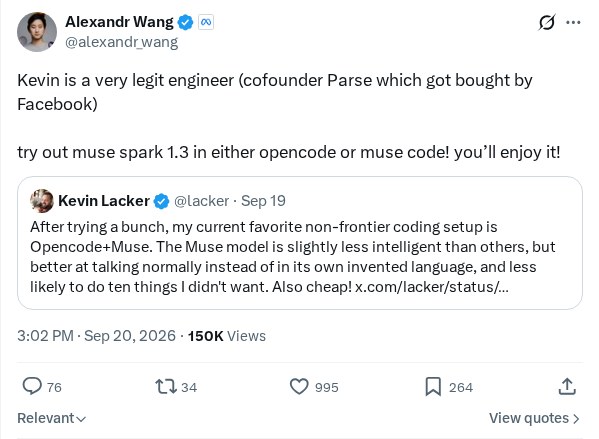
Summary: @Fei2411 said OpenCode V2 feels much better than v1, with Gemini 3.8 Flash and Step 5 looking stronger in that harness than in Antigravity / DeepSeek Harness / Codex. @alexandr_wang nudged people to try Muse Spark 1.3 in OpenCode or Muse Code.
Why it matters: Open harnesses and model-lab coding stacks keep cross-endorsing—pick both the model and the shell.
- OpenCode V2: https://x.com/Fei2411/status/2101699077096567214
- Muse Spark 1.3: https://x.com/alexandr_wang/status/2101567604204908900
10. Pi: Vienna Sunday meditation on agentic SE friction
Summary: From Vienna, @pidotdev shared a Sunday conversation where @mitsuhiko talks through shared frustrations of agentic software engineering—and reminds listeners they’re not alone. A nice counterpoint to today’s Harness Tax thread: the lightest shell is still talking honestly about how hard this feels.
Why it matters: Not a release note—harness authors naming why coding with agents still feels awkward.